

A Fully Updated 2024 NSE8_812 Exam Dumps - PDF Questions and Testing Engine
Easy Success Fortinet NSE8_812 Exam in First Try
NEW QUESTION # 29
Refer to the exhibit, which shows a Branch1 configuration and routing table.
In the SD-WAN implicit rule, you do not want the traffic load balance for the overlay interface when all members are available.
In this scenario, which configuration change will meet this requirement?
- A. Change the load-balance-mode to source-ip-based.
- B. Create a new static route with the internet sdwan-zone only
- C. Configure the cost in each overlay member to 10.
- D. Configure the priority in each overlay member to 10.
Answer: C
Explanation:
The SD-WAN implicit rule is a default rule that applies to all traffic that does not match any explicit SD-WAN rule. The SD-WAN implicit rule uses the best quality strategy, which selects the SD-WAN member with the best measured quality based on the performance SLA metrics. This means that the traffic load balance for the overlay interface will depend on the quality of each overlay member, which may vary over time. However, if the requirement is to minimize the overhead on the device for WAN traffic and avoid load balancing for the overlay interface when all members are available, one option is to configure the cost in each overlay member to 10. The cost is a parameter that can be used to influence the selection of an SD-WAN member by adding a penalty value to its quality score. By configuring the same cost value for all overlay members, the quality score of each member will be reduced by the same amount, which will make them less preferable than the underlay members. This way, the SD-WAN implicit rule will select the underlay members first, unless they are unavailable or out of SLA, and only use the overlay members as a backup option. Reference: https://docs.fortinet.com/document/fortigate/7.0.0/sd-wan/19662/sd-wan-rules
NEW QUESTION # 30
An automation stitch was configured using an incoming webhook as the trigger named 'my_incoming_webhook'. The action is configured to execute the CLI Script shown:
- A.

- B.

- C.

- D.

Answer: C
Explanation:
The CLI script in option A will send the log message to the webhook server. The webhook server can then be configured to take any desired action, such as storing the log message in a database or sending an email notification.
The other options are incorrect. Option B will not send the log message to the webhook server because it does not contain the curl command. Option C will send the log message to the webhook server, but it will also include the FortiGate's IP address and MAC address. This information is not necessary, and it could be used by an attacker to identify the FortiGate. Option D will not send the log message to the webhook server because it does not contain the webhook action.
References:
Automation webhook stitches: https://docs.fortinet.com/document/fortigate/7.4.0/administration-guide/989735/webhook-action Webhooks: https://en.wikipedia.org/wiki/Webhook
NEW QUESTION # 31
Refer to the exhibit.
A customer has deployed a FortiGate 200F high-availability (HA) cluster that contains & TPM chip. The exhibit shows output from the FortiGate CLI session where the administrator enabled TPM.
Following these actions, the administrator immediately notices that both FortiGate high availability (HA) status and FortiManager status for the FortiGate are negatively impacted.
What are the two reasons for this behavior? (Choose two.)
- A. Configuration for TPM is not synchronized between FortiGate HA cluster members.
- B. TPM functionality is not yet compatible with FortiGate HA D The administrator needs to manually enter the hex private data encryption key in FortiManager
- C. The FortiGate has not finished the auto-update process to synchronize the new configuration to FortiManager yet.
- D. The private-data-encryption key entered on the primary did not match the value that the TPM expected.
Answer: A,D
Explanation:
The two reasons for the negative impact on the FortiGate HA status and FortiManager status after enabling TPM are:
The private-data-encryption key entered on the primary unit did not match the value that the TPM expected. This could happen if the TPM was previously enabled and then disabled, and the key was changed in between. The TPM will reject the new key and cause an error in the configuration synchronization.
Configuration for TPM is not synchronized between FortiGate HA cluster members. Each cluster member must have the same private-data-encryption key to form a valid HA cluster and synchronize their configurations. However, enabling TPM on one unit does not automatically enable it on the other units, and the key must be manually entered on each unit. To resolve these issues, the administrator should disable TPM on all units, clear the TPM data, and then enable TPM again with the same private-data-encryption key on each unit. Reference: https://docs.fortinet.com/document/fortigate/6.4.0/cookbook/103437/inbound-ssl-inspection https://docs.fortinet.com/document/fortigate/6.4.0/cookbook/103438/application-detection-on-ssl-offloaded-traffic
NEW QUESTION # 32
Refer to the exhibits.

A customer is looking for a solution to authenticate the clients connected to a hardware switch interface of a FortiGate 400E.
Referring to the exhibits, which two conditions allow authentication to the client devices before assigning an IP address? (Choose two.)
- A. Client devices must have 802 1X authentication enabled
- B. FortiGate devices with NP6 and hardware switch interfaces cannot support 802.1X authentication.
- C. Ports 3 and 4 can be part of different switch interfaces.
- D. Devices connected directly to ports 3 and 4 can perform 802 1X authentication.
Answer: A,D
Explanation:
The customer wants to deploy a solution to authenticate the clients connected to a hardware switch interface of a FortiGate 400E device. A hardware switch interface is an interface that combines multiple physical interfaces into one logical interface, allowing them to act as a single switch with one IP address and one set of security policies. The customer wants to use 802.1X authentication for this solution, which is a standard protocol for port-based network access control (PNAC) that authenticates clients based on their credentials before granting them access to network resources. One condition that allows authentication to the client devices before assigning an IP address is that devices connected directly to ports 3 and 4 can perform 802.1X authentication. This is because ports 3 and 4 are part of the hardware switch interface named "lan", which has an IP address of 10.10.10.254/24 and an inbound SSL inspection profile named "ssl-inspection". The inbound SSL inspection profile enables the FortiGate device to intercept and inspect SSL/TLS traffic from clients before forwarding it to servers, which allows it to apply security policies and features such as antivirus, web filtering, application control, etc. However, before performing SSL inspection, the FortiGate device needs to authenticate the clients using 802.1X authentication, which requires the clients to send their credentials (such as username and password) to the FortiGate device over a secure EAP (Extensible Authentication Protocol) channel. The FortiGate device then verifies the credentials with an authentication server (such as RADIUS or LDAP) and grants or denies access to the clients based on the authentication result. Therefore, devices connected directly to ports 3 and 4 can perform 802.1X authentication before assigning an IP address. Another condition that allows authentication to the client devices before assigning an IP address is that client devices must have 802.1X authentication enabled. This is because 802.1X authentication is a mutual process that requires both the client devices and the FortiGate device to support and enable it. The client devices must have 802.1X authentication enabled in their network settings, which allows them to initiate the authentication process when they connect to the hardware switch interface of the FortiGate device. The client devices must also have an 802.1X supplicant software installed, which is a program that runs on the client devices and handles the communication with the FortiGate device using EAP messages. The client devices must also have a trusted certificate installed, which is used to verify the identity of the FortiGate device and establish a secure EAP channel. Therefore, client devices must have 802.1X authentication enabled before assigning an IP address. Reference: https://docs.fortinet.com/document/fortigate/7.0.0/administration-guide/19662/hardware-switch-interfaces https://docs.fortinet.com/document/fortigate/7.0.0/administration-guide/19662/802-1x-authentication
NEW QUESTION # 33
Refer to the exhibits.
Exhibit A
Exhibit B
Exhibit C
A customer is trying to set up a VPN with a FortiGate, but they do not have a backup of the configuration. Output during a troubleshooting session is shown in the exhibits A and B and a baseline VPN configuration is shown in Exhibit C Referring to the exhibits, which configuration will restore VPN connectivity?
- A.

- B.

- C.
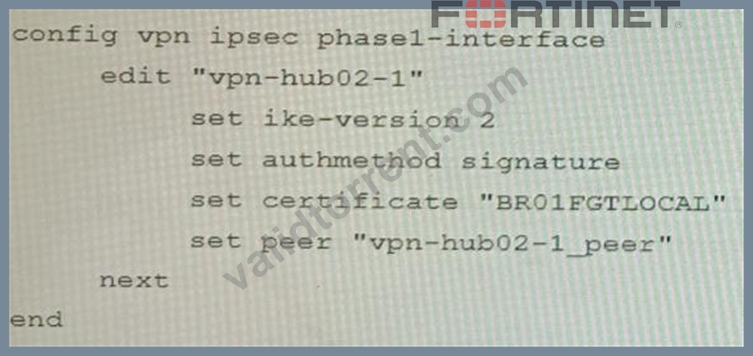
- D.

Answer: D
Explanation:
The output in Exhibit A shows that the VPN tunnel is not established because the peer IP address is incorrect. The output in Exhibit B shows that the peer IP address is 192.168.1.100, but the baseline VPN configuration in Exhibit C shows that the peer IP address should be 192.168.1.101.
To restore VPN connectivity, you need to change the peer IP address in the VPN tunnel configuration to 192.168.1.101. The correct configuration is shown below:
config vpn ipsec phase1-interface
edit "wan"
set peer-ip 192.168.1.101
set peer-id 192.168.1.101
set dhgrp 1
set auth-mode psk
set psk SECRET_PSK
next
end
Option A is incorrect because it does not change the peer IP address. Option B is incorrect because it changes the peer IP address to 192.168.1.100, which is the incorrect IP address. Option D is incorrect because it does not include the necessary configuration for the VPN tunnel.
NEW QUESTION # 34
Refer to the exhibit.
A FortiWeb appliance is configured for load balancing web sessions to internal web servers. The Server Pool is configured as shown in the exhibit.
How will the sessions be load balanced between server 1 and server 2 during normal operation?
- A. Server 1 will receive 33.3% of the sessions, Server 2 will receive 66 6% of the sessions
- B. Server 1 will receive 25% of the sessions, Server 2 will receive 75% of the sessions
- C. Server 1 will receive 0% of the sessions Server 2 will receive 100% of the sessions
- D. Server 1 will receive 20% of the sessions, Server 2 will receive 66.6% of the sessions
Answer: C
Explanation:
D is correct because server 1 has a weight of 0, which means it will not receive any sessions from the load balancer. Server 2 has a weight of 100, which means it will receive all sessions from the load balancer. This is explained in the FortiWeb Administration Guide under Server Load Balancing > Server pools > Weighted round robin. Reference: https://docs.fortinet.com/document/fortiweb/6.3.0/administration-guide/381057/server-load-balancing https://docs.fortinet.com/document/fortiweb/6.3.0/administration-guide/381057/server-load-balancing/381058/server-pools
NEW QUESTION # 35
What is the benefit of using FortiGate NAC LAN Segments?
- A. It provides support for multiple DHCP servers within the same VLAN.
- B. It provides support for IGMP snooping between hosts within the same VLAN
- C. It provides physical isolation without changing the IP address of hosts.
- D. It allows for assignment of dynamic address objects matching NAC policy.
Answer: D
Explanation:
FortiGate NAC LAN Segments are a feature that allows users to assign different VLANs to different LAN segments without changing the IP address of hosts or bouncing the switch port. This provides physical isolation while maintaining firewall sessions and avoiding DHCP issues. One benefit of using FortiGate NAC LAN Segments is that it allows for assignment of dynamic address objects matching NAC policy. This means that users can create firewall policies based on dynamic address objects that match the NAC policy criteria, such as device type, OS type, MAC address, etc. This simplifies firewall policy management and enhances security by applying different security profiles to different types of devices. Reference: https://docs.fortinet.com/document/fortigate/7.0.0/new-features/856212/nac-lan-segments-7-0-1
NEW QUESTION # 36
Refer to the exhibits.
The exhibits show a diagram of a requested topology and the base IPsec configuration.
A customer asks you to configure ADVPN via two internet underlays. The requirement is that you use one interface with a single IP address on DC FortiGate.
In this scenario, which feature should be implemented to achieve this requirement?
- A. Use local-id
- B. Use peer-id
- C. Change advpn2 to IKEv1
- D. Use network-overlay id
Answer: D
Explanation:
A is correct because using network-overlay id allows you to configure multiple ADVPN tunnels on a single interface with a single IP address on the DC FortiGate. This is explained in the FortiGate Administration Guide under ADVPN > Configuring ADVPN > Configuring ADVPN on the hub. References: https://docs.fortinet.com/document/fortigate/7.4.0/administration-guide/978793/advpn https://docs.fortinet.com/document/fortigate/7.4.0/administration-guide/978793/advpn/978794/configuring-advpn
NEW QUESTION # 37
Refer to the exhibit.
To facilitate a large-scale deployment of SD-WAN/ADVPN with FortiGate devices, you are tasked with configuring the FortiGate devices to support injecting of IKE routes on the ADVPN shortcut tunnels.
Which three commands must be added or changed to the FortiGate spoke config vpn ipsec phasei-interface options referenced in the exhibit for the VPN interface to enable this capability? (Choose three.)
- A. set add-route enable
- B. set mode-cfg enable
- C. set ike-version 1
- D. set mode-cfg-allow-client-selector enable
- E. set net-device disable
Answer: A,D,E
Explanation:
A is correct because net-device disable prevents the VPN interface from being added to the routing table as a connected route. This allows IKE routes to be injected instead. D is correct because add-route enable enables IKE route injection on the VPN interface. E is correct because mode-cfg-allow-client-selector enable allows the VPN interface to accept IKE routes from any peer that matches the phase 1 configuration. Reference: https://docs.fortinet.com/document/fortigate/7.0.1/administration-guide/490352/advpn https://docs.fortinet.com/document/fortigate/7.0.1/administration-guide/490352/advpn-configuration
NEW QUESTION # 38
A customer is planning on moving their secondary data center to a cloud-based laaS. They want to place all the Oracle-based systems Oracle Cloud, while the other systems will be on Microsoft Azure with ExpressRoute service to their main data center.
They have about 200 branches with two internet services as their only WAN connections. As a security consultant you are asked to design an architecture using Fortinet products with security, redundancy and performance as a priority.
Which two design options are true based on these requirements? (Choose two.)
- A. Systems running on Azure will need to go through the main data center to access the services on Oracle Cloud.
- B. Branch FortiGate devices must be configured as VPN clients for the branches' internal network to be able to access Oracle services without using public IPs.
- C. Two ExpressRoute services to the main data center are required to implement SD-WAN between a FortiGate VM in Azure and a FortiGate device at the data center edge
- D. Use FortiGate VM for IPSEC over ExpressRoute, as traffic is not encrypted by Azure.
Answer: A,B
Explanation:
a) Systems running on Azure will need to go through the main data center to access the services on Oracle Cloud. This is because the Oracle Cloud is not directly connected to the Azure Cloud. The traffic will need to go through the main data center in order to reach the Oracle Cloud.
c) Branch FortiGate devices must be configured as VPN clients for the branches' internal network to be able to access Oracle services without using public IPs. This is because the Oracle Cloud does not allow direct connections from the internet. The traffic will need to go through the FortiGate devices in order to reach the Oracle Cloud.
The other options are not correct.
b) Use FortiGate VM for IPSEC over ExpressRoute, as traffic is not encrypted by Azure. This is not necessary. Azure does encrypt traffic over ExpressRoute.
d) Two ExpressRoute services to the main data center are required to implement SD-WAN between a FortiGate VM in Azure and a FortiGate device at the data center edge. This is not necessary. A single ExpressRoute service can be used to implement SD-WAN between a FortiGate VM in Azure and a FortiGate device at the data center edge.
NEW QUESTION # 39
Refer to the exhibit.
A customer has deployed a FortiGate 300E with virtual domains (VDOMs) enabled in the multi-VDOM mode. There are three VDOMs: Root is for management and internet access, while VDOM 1 and VDOM 2 are used for segregating internal traffic. AccountVInk and SalesVInk are standard VDOM links in Ethernet mode.
Given the exhibit, which two statements below about VDOM behavior are correct? (Choose two.)
- A. You can apply OSPF routing on the VDOM link in either PPP or Ethernet mode
- B. Traffic on AccountVInk and SalesVInk will not be accelerated.
- C. Root VDOM is an Admin type VDOM, while VDOM 1 and VDOM 2 are Traffic type VDOMs.
- D. OSPF routing can be configured between VDOM 1 and Root VDOM without any configuration changes to AccountVInk
- E. The VDOM links are in Ethernet mode because they have IP addressed assigned on both sides.
Answer: A,C
Explanation:
a) You can apply OSPF routing on the VDOM link in either PPP or Ethernet mode. This is because VDOM links can be configured in either PPP or Ethernet mode, and OSPF routing can be configured on both types of links.
d) Root VDOM is an Admin type VDOM, while VDOM 1 and VDOM 2 are Traffic type VDOMs. This is because the Root VDOM is the default VDOM, and it is used for management and internet access. VDOM 1 and VDOM 2 are traffic type VDOMs, which are used for segregating internal traffic.
The other options are not correct.
b) Traffic on AccountVInk and SalesVInk will not be accelerated. This is because VDOM links are not accelerated by default. However, you can configure acceleration on VDOM links if you want.
c) The VDOM links are in Ethernet mode because they have IP addressed assigned on both sides. This is not necessarily true. The VDOM links could be in PPP mode even if they have IP addresses assigned on both sides.
e) OSPF routing can be configured between VDOM 1 and Root VDOM without any configuration changes to AccountVInk. This is correct. OSPF routing can be configured between any two VDOMs, even if they are not directly connected. In this case, the OSPF routing would be configured on the AccountVInk link.
NEW QUESTION # 40
Refer to the exhibit.
You are operating an internal network with multiple OSPF routers on the same LAN segment. FGT_3 needs to be added to the OSPF network and has the configuration shown in the exhibit. FGT_3 is not establishing any OSPF connection.
What needs to be changed to the configuration to make sure FGT_3 will establish OSPF neighbors without affecting the DR/BDR election?
- A.

- B.

- C.

- D.

Answer: B
Explanation:
The OSPF configuration shown in the exhibit is using the default priority value of 1 for the interface port1. This means that FGT_3 will participate in the DR/BDR election process with the other OSPF routers on the same LAN segment. However, this is not desirable because FGT_3 is a new device that needs to be added to the OSPF network without affecting the existing DR/BDR election. Therefore, to make sure FGT_3 will establish OSPF neighbors without affecting the DR/BDR election, the priority value of the interface port1 should be changed to 0. This will prevent FGT_3 from becoming a DR or BDR and allow it to form OSPF adjacencies with the current DR and BDR. Option B shows the correct configuration that changes the priority value to 0. Option A is incorrect because it does not change the priority value. Option C is incorrect because it changes the network type to point-to-point, which is not suitable for a LAN segment with multiple OSPF routers. Option D is incorrect because it changes the area ID to 0.0.0.1, which does not match the area ID of the other OSPF routers on the same LAN segment. Reference: https://docs.fortinet.com/document/fortigate/7.0.0/administration-guide/358640/basic-ospf-example
NEW QUESTION # 41
A remote worker requests access to an SSH server inside the network. You deployed a ZTNA Rule to their FortiClient. You need to follow the security requirements to inspect this traffic.
Which two statements are true regarding the requirements? (Choose two.)
- A. You need to configure a FortiClient SSL-VPN tunnel to inspect the SSH traffic.
- B. Traffic is discarded as ZTNA does not support SSH connection rules
- C. SSH traffic is tunneled between the client and the access proxy over HTTPS
- D. FortiGate can perform SSH access proxy host-key validation.
Answer: C,D
Explanation:
ZTNA supports SSH connection rules that allow remote workers to access SSH servers inside the network through an HTTPS tunnel between the client and the access proxy (FortiGate). The access proxy acts as an SSH client to connect to the real SSH server on behalf of the user, and performs host-key validation to verify the identity of the server. The user can use any SSH client that supports HTTPS proxy settings, such as PuTTY or OpenSSH. References: https://docs.fortinet.com/document/fortigate/7.0.0/ztna-deployment/899992/configuring-ztna-rules-to-control-access
NEW QUESTION # 42
Refer to the exhibit.
A customer wants FortiClient EMS configured to deploy to 1500 endpoints. The deployment will be integrated with FortiOS and there is an Active Directory server.
Given the configuration shown in the exhibit, which two statements about the installation are correct? (Choose two.)
- A. If no client update time is specified on EMS, the user will be able to choose the time of installation if they wish to delay.
- B. You can only deploy initial installations to Windows clients.
- C. A client can be eligible for multiple enabled configurations on the EMS server, and one will be chosen based on first priority
- D. The Windows clients only require "File and Printer Sharing0 allowed and the rest is handled by Active Directory group policy
- E. You must use Standard or Enterprise SQL Server rather than the included SQL Server Express
Answer: B,C
Explanation:
B is correct because a client can be eligible for multiple enabled configurations on the EMS server, and one will be chosen based on first priority. This is explained in the FortiClient EMS Administration Guide under Deployment & Installers > Manage Deployment > Managing deployment configuration priority levels. C is correct because you can only deploy initial installations to Windows clients using FortiClient EMS. This is also explained in the FortiClient EMS Administration Guide under Deployment & Installers > Deploying FortiClient software to endpoints. Reference: https://docs.fortinet.com/document/forticlient/7.0.7/ems-administration-guide/278884/deployment-installers https://docs.fortinet.com/document/forticlient/7.0.7/ems-administration-guide/374506/deploying-forticlient-software-to-endpoints
NEW QUESTION # 43
Refer to the exhibit.
You have deployed a security fabric with three FortiGate devices as shown in the exhibit. FGT_2 has the following configuration:
FGT_1 and FGT_3 are configured with the default setting. Which statement is true for the synchronization of fabric-objects?
- A. Objects from the root FortiGate will only be synchronized to FGT_3.
- B. Objects from the root FortiGate will not be synchronized to any downstream FortiGate.
- C. Objects from the FortiGate FGT_2 will be synchronized to the upstream FortiGate.
- D. Objects from the root FortiGate will only be synchronized to FGT__2.
Answer: B
Explanation:
The fabric-object-unification setting on FGT_2 is set to local, which means that objects will not be synchronized to any other FortiGate devices in the security fabric. The default setting for fabric-object-unification is default, which means that objects will be synchronized from the root FortiGate to all downstream FortiGate devices.
Since FGT_2 is not the root FortiGate and the fabric-object-unification setting is set to local, objects from the root FortiGate will not be synchronized to FGT_2.
Reference:
Synchronizing objects across the Security Fabric: https://docs.fortinet.com/document/fortigate/6.4.0/administration-guide/880913/synchronizing-objects-across-the-security-fabric
NEW QUESTION # 44
A remote worker requests access to an SSH server inside the network. You deployed a ZTNA Rule to their FortiClient. You need to follow the security requirements to inspect this traffic.
Which two statements are true regarding the requirements? (Choose two.)
- A. You need to configure a FortiClient SSL-VPN tunnel to inspect the SSH traffic.
- B. Traffic is discarded as ZTNA does not support SSH connection rules
- C. SSH traffic is tunneled between the client and the access proxy over HTTPS
- D. FortiGate can perform SSH access proxy host-key validation.
Answer: C,D
Explanation:
ZTNA supports SSH connection rules that allow remote workers to access SSH servers inside the network through an HTTPS tunnel between the client and the access proxy (FortiGate). The access proxy acts as an SSH client to connect to the real SSH server on behalf of the user, and performs host-key validation to verify the identity of the server. The user can use any SSH client that supports HTTPS proxy settings, such as PuTTY or OpenSSH. Reference: https://docs.fortinet.com/document/fortigate/7.0.0/ztna-deployment/899992/configuring-ztna-rules-to-control-access
NEW QUESTION # 45
Wh.ch feature must you enable on the BGP neighbors to accomplish this goal?
- A. Soft-reconfiguration
- B. Deterministic-med
- C. Graceful-restart
- D. Synchronization
Answer: C
Explanation:
Graceful-restart is a feature that allows BGP neighbors to maintain their routing information during a BGP restart or failover event, without disrupting traffic forwarding or causing route flaps. Graceful-restart works by allowing a BGP speaker (the restarting router) to notify its neighbors (the helper routers) that it is about to restart or failover, and request them to preserve their routing information and forwarding state for a certain period of time (the restart time). The helper routers then mark the routes learned from the restarting router as stale, but keep them in their routing table and continue forwarding traffic based on them until they receive an end-of-RIB marker from the restarting router or until the restart time expires. This way, graceful-restart can minimize traffic disruption and routing instability during a BGP restart or failover event. Reference: https://docs.fortinet.com/document/fortigate/7.0.0/cookbook/19662/bgp-graceful-restart
NEW QUESTION # 46
What is the benefit of using FortiGate NAC LAN Segments?
- A. It provides support for multiple DHCP servers within the same VLAN.
- B. It provides support for IGMP snooping between hosts within the same VLAN
- C. It provides physical isolation without changing the IP address of hosts.
- D. It allows for assignment of dynamic address objects matching NAC policy.
Answer: D
Explanation:
FortiGate NAC LAN Segments are a feature that allows users to assign different VLANs to different LAN segments without changing the IP address of hosts or bouncing the switch port. This provides physical isolation while maintaining firewall sessions and avoiding DHCP issues. One benefit of using FortiGate NAC LAN Segments is that it allows for assignment of dynamic address objects matching NAC policy. This means that users can create firewall policies based on dynamic address objects that match the NAC policy criteria, such as device type, OS type, MAC address, etc. This simplifies firewall policy management and enhances security by applying different security profiles to different types of devices. References: https://docs.fortinet.com/document/fortigate/7.0.0/new-features/856212/nac-lan-segments-7-0-1
NEW QUESTION # 47
Refer to the exhibit.
The exhibit shows two error messages from a FortiGate root Security Fabric device when you try to configure a new connection to a FortiClient EMS Server.
Referring to the exhibit, which two actions will fix these errors? (Choose two.)
- A. Export and import the FortiClient EMS server certificate to the root FortiGate.
- B. Verify that the CRL is accessible from the root FortiGate
- C. Install a new known CA on the Win2K16-EMS server.
- D. Authorize the root FortiGate on the FortiClient EMS
Answer: B,D
Explanation:
A is correct because the error message "The CRL is not accessible" indicates that the root FortiGate cannot access the CRL for the FortiClient EMS server. Verifying that the CRL is accessible will fix this error.
D is correct because the error message "The FortiClient EMS server is not authorized" indicates that the root FortiGate is not authorized to connect to the FortiClient EMS server. Authorizing the root FortiGate on the FortiClient EMS server will fix this error.
The other options are incorrect. Option B is incorrect because exporting and importing the FortiClient EMS server certificate to the root FortiGate will not fix the CRL error. Option C is incorrect because installing a new known CA on the Win2K16-EMS server will not fix the authorization error.
References:
Troubleshooting FortiClient EMS connectivity | FortiClient / FortiOS 7.0.0 - Fortinet Document Library Authorizing FortiGates with FortiClient EMS | FortiClient / FortiOS 6.4.8 - Fortinet Document Library
NEW QUESTION # 48
A customer's cybersecurity department needs to implement security for the traffic between two VPCs in AWS, but these belong to different departments within the company. The company uses a single region for all their VPCs.
Which two actions will achieve this requirement while keeping separate management of each department's VPC? (Choose two.)
- A. Create an 1AM account for the cybersecurity department to manage both existing VPC, create a FortiGate HA Cluster on each VPC and IPSEC VPN to force traffic between the VPCs through the FortiGate clusters
- B. Migrate all the instances to the same VPC and create 1AM accounts for each department, then implement a new subnet for a FortiGate auto-scaling group and use routing tables to force the traffic through the FortiGate cluster.
- C. Create a VPC with a FortiGate auto-scaling group with a Transit Gateway attached to the three VPC to force routing through the FortiGate cluster
- D. Create a transit VPC with a FortiGate HA cluster, connect to the other two using VPC peering, and use routing tables to force traffic through the FortiGate cluster.
Answer: C,D
Explanation:
To implement security for the traffic between two VPCs in AWS, while keeping separate management of each department's VPC, two possible actions are:
Create a transit VPC with a FortiGate HA cluster, connect to the other two using VPC peering, and use routing tables to force traffic through the FortiGate cluster. This option allows the cybersecurity department to manage the transit VPC and apply security policies on the FortiGate cluster, while the other departments can manage their own VPCs and instances. The VPC peering connections enable direct communication between the VPCs without using public IPs or gateways. The routing tables can be configured to direct all inter-VPC traffic to the transit VPC.
Create a VPC with a FortiGate auto-scaling group with a Transit Gateway attached to the three VPCs to force routing through the FortiGate cluster. This option also allows the cybersecurity department to manage the security VPC and apply security policies on the FortiGate cluster, while the other departments can manage their own VPCs and instances. The Transit Gateway acts as a network hub that connects multiple VPCs and on-premises networks. The routing tables can be configured to direct all inter-VPC traffic to the security VPC. References: https://docs.fortinet.com/document/fortigate-public-cloud/7.2.0/aws-administration-guide/506140/connecting-a-local-fortigate-to-an-aws-vpc-vpn https://docs.fortinet.com/document/fortigate-public-cloud/7.0.0/sd-wan-architecture-for-enterprise/166334/sd-wan-configuration
NEW QUESTION # 49
......
NSE8_812 Study Material, Preparation Guide and PDF Download: https://www.validtorrent.com/NSE8_812-valid-exam-torrent.html
Best NSE8_812 Exam Dumps for the Preparation of Latest Exam Questions: https://drive.google.com/open?id=1u7avLgJiVnz3mD25sImX8MWGeCjlphql