

[UPDATED Sep-2022] Best Value Available Preparation Guide for IIA-CIA-Part1 Exam
1 Full IIA-CIA-Part1 Practice Test and 463 Unique Questions, Get it Now!
How exactly to prepare for the IIA-CIA-Part1 exam
What is the prep work standards for IIA-CIA-Part1 Exam
Swiftly checked out the review of IIA-CIA-Part1 Exam
The IIA provides two main global certifications: Certified Internal Auditor (CIA) and Certification in Risk Management Assurance (CRMA). The CIA is the first accreditation and classification for internal auditors that the IIA suggests that all internal auditors pursue and have. The CIA not only shows your credibility as an internal audit expert, but it also gives you a competitive advantage over your peers. The CIA is a three-part exam that covers the understanding, skills, and abilities required by today's internal listeners.
As a professional accountant or auditor seeking to energize your profession, you may have considered earning an audit certification. But you have several options for qualifying in accounting, so which one should you choose? if you intend to go down the path of an internal auditor, after that, Certified Internal Auditor (CIA) is the certification for you.
What are the topics covered in IIA-CIA-Part1 Exam
Candidates must know the topics before they start of preparation. Because it will really help them in hitting the core. Our IIA-CIA-Part1 Exam exam dumps will include the following topics:
- Proficiency and Due Professional Care (18%)
- Quality Assurance and Improvement Program (7%)
- Governance, Risk Management, and Control (35%)
Salary of IIA-CIA-Part1 Professional
The average Salary of a IIA-CIA-Part1
- England - 52802 POUND
- India - 5170273 INR
- Europe - 58621 EURO
- United State - 69,000 USD
NEW QUESTION 50
An internal auditor has completed an assurance engagement Which of the following is most likely true regarding the engagement?
- A. During audit planning, the auditor determined that the engagement scope would include a review of the security and privacy of payroll records
- B. The results of the engagement were included in a written report that was issued to the client who requested the engagement
- C. During audit planning, the auditor provided the client with the scope of the engagement for their agreement
- D. The client requested the review of a new payroll system in order to improve the security of the system
Answer: A
NEW QUESTION 51
Which of the following best describes the risk created when a manager bypasses organizational policies and procedures in order to meet an organization's objective?
- A. Monitoring failure risk.
- B. Knowledge/skills risk
- C. Communication failure risk.
- D. Accountability/reward risk.
Answer: D
NEW QUESTION 52
Which of the following is most accurate concerning corporate social responsibility?
- A. Ethics are not defined by laws but they are not a matter of free choice ethics are based on standards of conduct derived from shared principles and values
- B. The utilitarian approaching deciding on ethical dilemmas is concerned with choosing the simplest solution that will apply to the most people
- C. The individualism approach to ethical decision making is focused on implementing a customized long-term outcome that is most beneficial for the entire organization
- D. A moral agent in an organization makes decisions that are based on the rules and regulations of the organization as they apply to human resources decisions
Answer: A
NEW QUESTION 53
Which of the following is most likely to be considered a control weakness?
- A. Vendor invoice payment requests are accompanied by a purchase order and receiving report.
- B. Department managers initiate purchase requests that must be approved by the plant superintendent.
- C. Buyers promptly update the official vendor listing as new supplier sources become known.
- D. Purchase orders are typed by the purchasing department using prenumbered forms.
Answer: C
NEW QUESTION 54
Which of the following describes the internal audit activity's most appropriate role in an organization's risk management process?
- A. Reporting to the board on management's assessment of current risks
- B. Establishing a risk management policy and framework for the organization
- C. Assigning responsibility for identifying and managing significant risks
- D. Developing key controls to mitigate risks across the organization
Answer: A
NEW QUESTION 55
Which of the following scenarios exemplifies a potential internal control weakness?
- A. The same employee who makes deposits at the bank prepares the monthly bank reconciliation.
- B. The same employee who restrictively endorses checks received from customers prepares the bank's check deposit slips.
- C. The same employee who receives cash from customers prepares a prelisting of cash receipts.
- D. The same employee who records cash receipts in the accounts receivable subsidiary ledger ensures that the ledger automatically updates the information.
Answer: A
NEW QUESTION 56
Which of the following types of information would an internal auditor expect to find in the supporting documentation for a high-level accounts payable process flowchart?
- A. An overview of the steps for validating invoices.
- B. A copy of the new customer request form.
- C. The number of payments paid before the due date of the invoice.
- D. The payment terms and credit limit of the vendor to be paid.
Answer: A
NEW QUESTION 57
Which of the following describes a control weakness?
- A. Normal operational purchases fall in the range from $500 to $1, 000 with two signatures required for purchases over $1, 000.
- B. Pre-numbered blank purchase orders are secured within the purchasing department.
- C. The purchasing agent invests in a publicly traded mutual fund that lists the stock of one of the company's suppliers in its portfolio.
- D. Purchasing procedures are well designed and are followed unless otherwise directed by the purchasing supervisor.
Answer: D
Explanation:
Section: Volume A
NEW QUESTION 58
Which of the following internal controls is likely to prevent pollution from waste disposal before it occurs, rather than detect it after it occurs?
- A. Samples of water and solid waste taken daily with the results recorded in a log.
- B. Restricted access to environmental department files.
- C. Formal on-the-job training program conducted by the environmental staff.
- D. Identification of large budget variances in disposal costs for hazardous chemicals.
Answer: C
NEW QUESTION 59
In preparing for an audit of the footwear division of a major retail organization, an internal auditor gathered the following information about the organization's stores: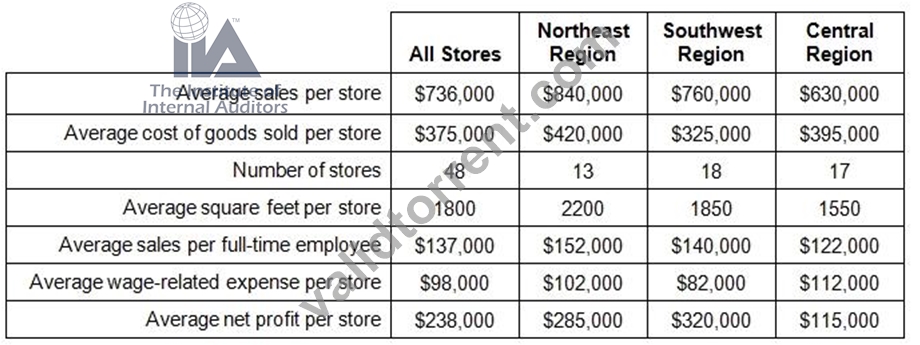
In addition to labor costs, the other costs associated with each store are leasing and maintenance expenses. Which of the following is a valid conclusion?
- A. Cost of goods sold is directly related to the size of the store.
- B. Gross margin is directly related to the size of the store.
- C. Sales per store are directly related to the size of the store.
- D. Employees are less productive in larger stores.
Answer: C
NEW QUESTION 60
Two individuals are being considered for an audit team that is to perform a highly technical review. Which of the following situations would preclude selection of the individual for the audit due to an objectivity concern?
I.Person A is a member of the internal audit staff and has the required technical skills. Person A participated in a controls review of the system to be audited when it was being developed.
II.
Person B is a technical specialist who understands the audit area but is not a member of the internal audit staff. Although person B has personal credibility in the information systems department to be audited, person B works for another department in the organization.
- A. I only.
- B. Neither I nor II.
- C. Both I and II.
- D. II only.
Answer: B
NEW QUESTION 61
Which of the following is a second line of defense in effective risk management and control?
- A. Credit department.
- B. Internal audit department.
- C. Compliance department.
- D. Purchasing department.
Answer: C
Explanation:
Section: Volume E
NEW QUESTION 62
Which of the following conditions is the most likely indicator of fraud?
- A. Commissions are paid based on verified increases to sales.
- B. A manager regularly assumes subordinates' duties.
- C. Lower earnings occur during the industry's down cycle.
- D. Departmental reports are consistently issued in an untimely manner.
Answer: B
NEW QUESTION 63
A fast-food company is developing a computer simu-lation involving arrival time at a drive-through restaurant. The distribution for arrival times is:
Time
Single-Digit Random
Between Arrivals Probability Number Assigned
2 minutes
0.1 0
3 minutes
0.2 1, 2
4 minutes 0.3
3, 4,5
5 minutes
0.4
6, 7,8, 9
Six random numbers are selected to represent the arrival of six cars: 1, 6, 9, 0, 5, 6.
What is the mean time between arrivals in this run of the simu-lation model?
- A. 3 minutes.
- B. 5 minutes.
- C. 2 minutes.
- D. 4 minutes.
Answer: D
NEW QUESTION 64
A candidate has applied for an entry level internal audit position. The candidate holds a CISA (Certified Information Systems Auditor) designation, and has six months of audit experience, but limited knowledge of accounting principles and techniques. According to the IIA guidance, which of the following is the most relevant reason for the chief audit executive to consider this candidate?
- A. An entry level position does not require expertise in any particular area.
- B. The candidate's information systems knowledge and real-world experience in internal auditing.
- C. Other internal auditors possess sufficient knowledge of accounting principles and techniques.
- D. Accounting skills can be learned over time with appropriate training.
Answer: B
NEW QUESTION 65
COBIT is primarily designed to:
- A. Assist technology professionals in interpreting technological specifications.
- B. Provide guidance to govern information technology activities.
- C. Satisfy information technology regulatory requirements.
- D. Define auditing standards for information technology auditors.
Answer: B
NEW QUESTION 66
The chief audit executive (CAE) is planning to conduct an internal assessment of the internal audit activity (IAA). Part of this assessment will include benchmarking. According to IIA guidance, which of the following qualitative metrics would be appropriate for the CAE to use?
Average client customer satisfaction score for a given year.
Client survey comments on how to improve the IAA.
Auditor interviews once an audit has been completed.
Percentage of audits completed within 90 days.
- A. 1 and 2.
- B. 2 and 3.
- C. 1 and 3.
- D. 3 and 4.
Answer: B
NEW QUESTION 67
An internal auditor has been engaged to assess fraud risks associated with a new financial
software system.
Which competency would best help the auditor complete the task?
- A. Expertise in identifying information technology risks.
- B. A thorough understanding of organizational governance principles.
- C. Proficiency in creating and utilizing process maps.
- D. Knowledge of key management and business principles.
Answer: A
NEW QUESTION 68
Which of the following, other than the internal audit charter, is most likely to define the purpose, authority, and responsibility of the internal audit activity (IAA)?
- A. The internal audit policy statement.
- B. The organization's charter to conduct operations.
- C. The IAA vision statement.
- D. The chief audit executive job description.
Answer: A
Explanation:
Section: Volume C
NEW QUESTION 69
......
Get Instant Access to IIA-CIA-Part1 Practice Exam Questions: https://www.validtorrent.com/IIA-CIA-Part1-valid-exam-torrent.html
The Best IIA-CIA-Part1 Exam Study Material Premium Files and Preparation Tool: https://drive.google.com/open?id=1cgaV77QeS-kJnCkjsVWCXfRuwajahxp5