

2026 Updated DP-300 PDF for the DP-300 Tests Free Updated Today!
Fully Updated Dumps PDF - Latest DP-300 Exam Questions and Answers
NEW QUESTION # 256
You have an Azure SQL database.
You need to identify whether a delayed query execution is associated to a RESOURCE wait.
How should you complete the Transact -SQL statement? To answer, select the appropriate option in the answer area.
NOTE: Each correct selection is worth one point.
Answer:
Explanation:
Explanation:
NEW QUESTION # 257
You have an Azure SQL database that contains a table named Employees. Employees contains a column named Salary.
You need to encrypt the Salary column. The solution must prevent database administrators from reading the data in the Salary column and must provide the most secure encryption.
Which three actions should you perform in sequence? To answer, move the appropriate actions from the list of actions to the answer area and arrange them in the correct order.
Answer:
Explanation:
1 - Create a column master key
2 - Create a column encryption key.
3 - Encrypt the Salary column by using the randomized encryption type.
Reference:
https://docs.microsoft.com/en-us/sql/relational-databases/security/encryption/always-encrypted-database-engine
NEW QUESTION # 258
You are provisioning an Azure SQL database in the Azure portal as shown in the following exhibit.
Use the drop-down menus to select the answer choice that completes each statement based on the information presented in the graphic.
NOTE: Each correct selection is worth one point.
Answer:
Explanation:
Reference:
https://docs.microsoft.com/en-us/azure/azure-sql/database/serverless-tier-overview
NEW QUESTION # 259
Your on-premises network contains a Microsoft SQL Server 2016 server that hosts a database named db1.
You have an Azure subscription.
You plan to migrate db1 to an Azure SQL managed instance.
You need to create the SQL managed instance. The solution must minimize the disk latency of the instance.
Which service tier should you use?
- A. General Purpose
- B. Business Critical
- C. Hyperscale
- D. Premium
Answer: B
NEW QUESTION # 260
Hotspot Question
You have an Azure SQL database.
You are reviewing a slow performing query as shown in the following exhibit.
Use the drop-down menus to select the answer choice that completes each statement based on the information presented in the graphic.
NOTE: Each correct selection is worth one point.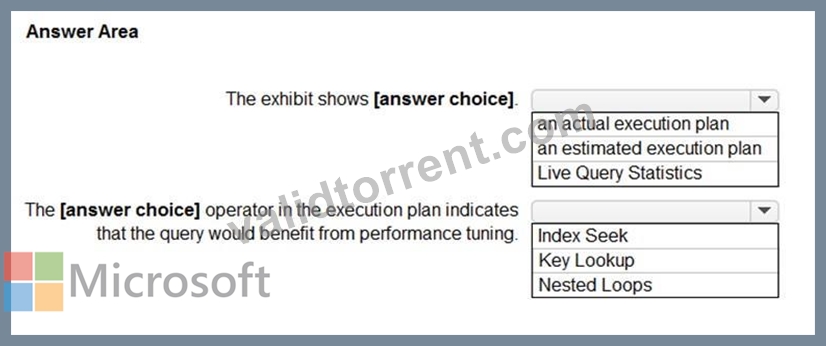
Answer:
Explanation: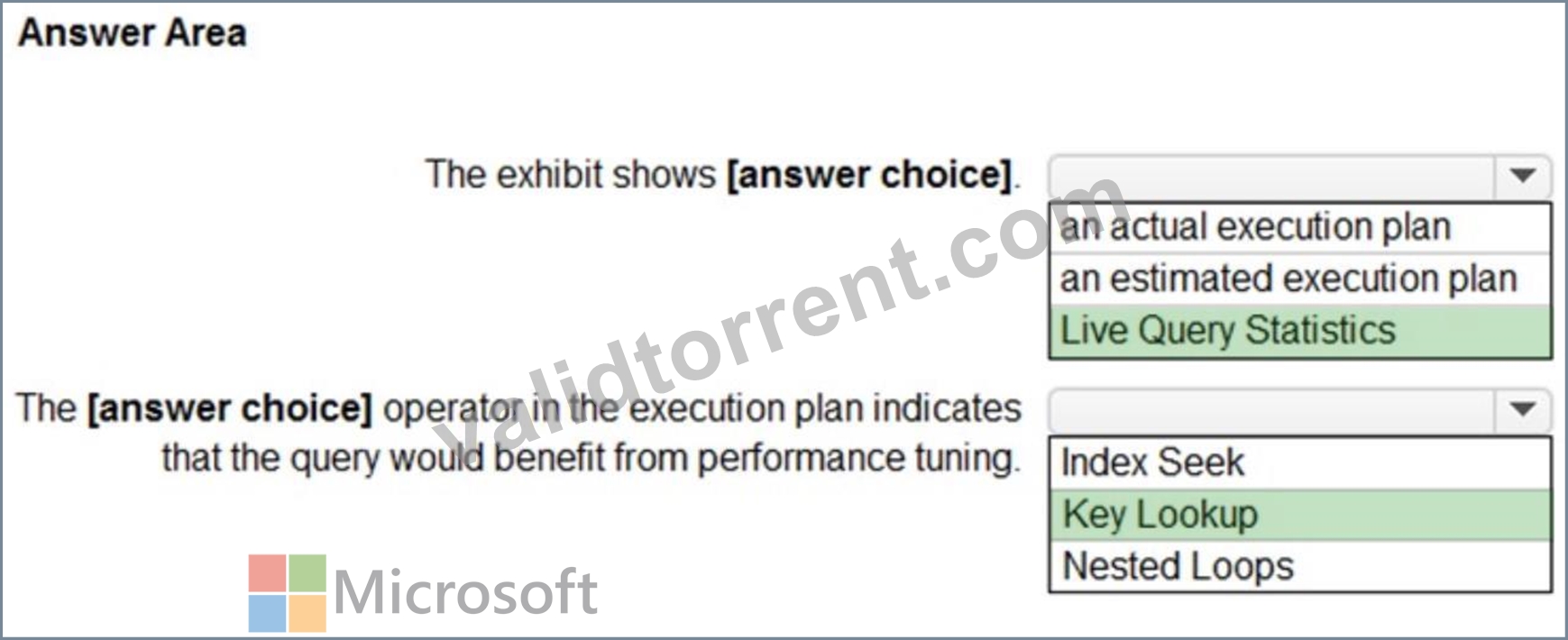
Explanation:
Box 1: Live Query Statistics
Live Query Statistics as it a percentage of the execution.
Box 2: Key Lookup
The use of a Key Lookup operator in a query plan indicates that the query might benefit from performance tuning. For example, query performance might be improved by adding a covering index.
Reference:
https://docs.microsoft.com/en-us/sql/relational-databases/performance/live-query-statistics?view=sql-server-ver15
https://docs.microsoft.com/en-us/sql/relational-databases/showplan-logical-and-physical-operators-reference
NEW QUESTION # 261
You have SQL Server on an Azure virtual machine.
You review the query plan shown in the following exhibit.
For each of the following statements, select yes if the statement is true. Otherwise, select no.
NOTE: Each correct selection is worth one point.
Answer:
Explanation:
Explanation:
Reference:
https://docs.microsoft.com/en-us/sql/relational-databases/performance/monitoring-performance-by-using-the-que
NEW QUESTION # 262
You have an Azure SQL database named sqldb1.
You need to minimize the possibility of Query Store transitioning to a read-only state.
What should you do?
- A. Halve the value of Data Flush Interval.
- B. Halve the value of Statistics Collection Interval.
- C. Double the value of Data Flush Interval.
- D. Double the value of Statistics Collection Interval.
Answer: D
Explanation:
The Max Size (MB) limit isn't strictly enforced. Storage size is checked only when Query Store writes data to disk. This interval is set by the Data Flush Interval (Minutes) option. If Query Store has breached the maximum size limit between storage size checks, it transitions to read-only mode.
Reference:
https://docs.microsoft.com/en-us/sql/relational-databases/performance/best-practice-with-the-query-store
NEW QUESTION # 263
Note: This question is part of a series of questions that present the same scenario. Each question in the series contains a unique solution that might meet the stated goals. Some question sets might have more than one correct solution, while others might not have a correct solution.
After you answer a question in this section, you will NOT be able to return to it. As a result, these questions will not appear in the review screen.
You have an Azure SQL database named Sales.
You need to implement disaster recovery for Sales to meet the following requirements:
During normal operations, provide at least two readable copies of Sales.
Ensure that Sales remains available if a datacenter fails.
Solution: You deploy an Azure SQL database that uses the Business Critical service tier and Availability Zones.
Does this meet the goal?
- A. Yes
- B. No
Answer: A
Explanation:
Premium and Business Critical service tiers leverage the Premium availability model, which integrates compute resources (sqlservr.exe process) and storage (locally attached SSD) on a single node. High availability is achieved by replicating both compute and storage to additional nodes creating a three to four-node cluster.
By default, the cluster of nodes for the premium availability model is created in the same datacenter. With the introduction of Azure Availability Zones, SQL Database can place different replicas of the Business Critical database to different availability zones in the same region. To eliminate a single point of failure, the control ring is also duplicated across multiple zones as three gateway rings (GW).
Reference:
https://docs.microsoft.com/en-us/azure/azure-sql/database/high-availability-sla
NEW QUESTION # 264
You configure version control for an Azure Data Factory instance as shown in the following exhibit.
Use the drop-down menus to select the answer choice that completes each statement based on the information presented in the graphic.
NOTE: Each correct selection is worth one point.
Answer:
Explanation:
Reference:
https://docs.microsoft.com/en-us/azure/data-factory/source-control
NEW QUESTION # 265
You configure backup for an Azure SQL database as shown in the following exhibit.
Use the drop-down menus to select the answer choice the completes each statement based on the information presented in the graphic.
NOTE: Each correct selection is worth one point.
Answer:
Explanation:
Explanation:
NEW QUESTION # 266
You have a 50-TB Microsoft SQL Server database named DB1.
You need to reduce the time it takes to perform database consistency checks of DB1.
Which Transact-SQL command should you run? To answer, select the appropriate options in the answer area.
NOTE: Each correct selection is worth one point.
Answer:
Explanation:
Explanation:
Table Description automatically generated with low confidence
Reference:
https://docs.microsoft.com/en-us/sql/t-sql/database-console-commands/dbcc-checkdb-transact-sql?view=sql-serv
NEW QUESTION # 267
You have an Azure SQL managed instance.
You need to enable SQL Agent Job email notifications.
What should you do?
- A. Enable the SQL Server Agent.
- B. Run the sp_configure command.
- C. Use the Agent XPs option.
- D. Run the sp set_agent properties command.
Answer: B
NEW QUESTION # 268
You have a database on a SQL Server on Azure Virtual Machines instance.
The current state of Query Store for the database is shown in the following exhibit.


Answer:
Explanation:
Explanation:
Graphical user interface, text Description automatically generated
NEW QUESTION # 269
Hotspot Question
You have an Azure data factory that has two pipelines named PipelineA and PipelineB.
PipelineA has four activities as shown in the following exhibit.
PipelineB has two activities as shown in the following exhibit.
You create an alert for the data factory that uses Failed pipeline runs metrics for both pipelines and all failure types. The metric has the following settings:
- Operator: Greater than
- Aggregation type: Total
- Threshold value: 2
- Aggregation granularity (Period): 5 minutes
- Frequency of evaluation: Every 5 minutes
Data Factory monitoring records the failures shown in the following table.
For each of the following statements, select Yes if the statement is true. Otherwise, select No.
NOTE: Each correct selection is worth one point.
Answer:
Explanation:
Explanation:
Box 1: No
Just one failure within the 5-minute interval.
Box 2: No
Just two failures within the 5-minute interval.
Box 3: No
Just two failures within the 5-minute interval.
Reference:
https://docs.microsoft.com/en-us/azure/azure-monitor/alerts/alerts-metric-overview
NEW QUESTION # 270
You have an Azure data factory that has two pipelines named PipelineA and PipelineB.
PipelineA has four activities as shown in the following exhibit.
PipelineB has two activities as shown in the following exhibit.
You create an alert for the data factory that uses Failed pipeline runs metrics for both pipelines and all failure types. The metric has the following settings:
Operator: Greater than
Aggregation type: Total
Threshold value: 2
Aggregation granularity (Period): 5 minutes
Frequency of evaluation: Every 5 minutes
Data Factory monitoring records the failures shown in the following table.
For each of the following statements, select Yes if the statement is true. Otherwise, select No.
NOTE: Each correct selection is worth one point.
Answer:
Explanation:
Reference:
https://docs.microsoft.com/en-us/azure/azure-monitor/alerts/alerts-metric-overview
NEW QUESTION # 271
You have an Azure subscription.
You need to deploy an Azure SQL resource that will support cross database queries by using an Azure Resource Manager (ARM) template.
How should you complete the ARM template? To answer, select the appropriate options in the answer area.
NOTE: Each correct selection is worth one point.
Answer:
Explanation:
Explanation
Graphical user interface, text, application, Word, email Description automatically generated
Reference:
https://docs.microsoft.com/en-us/azure/azure-sql/managed-instance/create-template-quickstart?tabs=azure-power
NEW QUESTION # 272
You have an Azure SQL database.
You have a query and the associated execution plan as shown in the following exhibit.
Use the drop-down menus to select the answer choice that completes each statement based on the information presented in the graphic.
NOTE: Each correct selection is worth one point.
Answer:
Explanation:
NEW QUESTION # 273
You need to implement statistics maintenance for SalesSQLDb1. The solution must meet the technical requirements.
Which four actions should you perform in sequence? To answer, move the appropriate actions from the list of actions to the answer area and arrange them in the correct order.
Answer:
Explanation:
Explanation:
Automating Azure SQL DB index and statistics maintenance using Azure Automation:
1. Create Azure automation account (Step 1)
2. Import SQLServer module (Step 2)
3. Add Credentials to access SQL DB
This will use secure way to hold login name and password that will be used to access Azure SQL DB
4. Add a runbook to run the maintenance (Step 3)
Steps: 1. Click on "runbooks" at the left panel and then click "add a runbook"
2. Choose "create a new runbook" and then give it a name and choose "Powershell" as the type of the runbook and then click on "create"
5. Schedule task (Step 4)
Steps:1. Click on Schedules2. Click on "Add a schedule" and follow the instructions to choose existing schedule or create a new schedule.
Reference:
https://techcommunity.microsoft.com/t5/azure-database-support-blog/automating-azure-sql-db-index-and- statistics-maintenance-using/ba-p/368974
NEW QUESTION # 274
You plan to move two 100-GB databases to Azure.
You need to dynamically scale resources consumption based on workloads. The solution must minimize downtime during scaling operations.
What should you use?
- A. two databases hosted in SQL Server on an Azure virtual machine
- B. two databases in an Azure SQL Managed instance
- C. two Azure SQL Databases in an elastic pool
- D. two single Azure SQL databases
Answer: C
Explanation:
Section: [none]
Explanation:
Azure SQL Database elastic pools are a simple, cost-effective solution for managing and scaling multiple databases that have varying and unpredictable usage demands. The databases in an elastic pool are on a single server and share a set number of resources at a set price.
Reference:
https://docs.microsoft.com/en-us/azure/azure-sql/database/elastic-pool-overview
NEW QUESTION # 275
You have 20 Azure SQL databases provisioned by using the vCore purchasing model.
You plan to create an Azure SQL Database elastic pool and add the 20 databases.
Which three metrics should you use to size the elastic pool to meet the demands of your workload? Each correct answer presents part of the solution.
NOTE: Each correct selection is worth one point.
- A. number of concurrently peaking databases * peak CPU utilization per database
- B. geo-replication support
- C. total number of databases * average CPU utilization per database
- D. total size of all the databases
- E. maximum number of concurrent sessions for all the databases
Answer: A,C,D
Explanation:
CE: Estimate the vCores needed for the pool as follows:
For vCore-based purchasing model: MAX(<Total number of DBs X average vCore utilization per DB>, <Number of concurrently peaking DBs X Peak vCore utilization per DB) A: Estimate the storage space needed for the pool by adding the number of bytes needed for all the databases in the pool.
Reference:
https://docs.microsoft.com/en-us/azure/azure-sql/database/elastic-pool-overview
NEW QUESTION # 276
You have an Azure subscription that contains an Azure SQL database named SQLDb1. SQLDb1 contains a table named Table1.
You plan to deploy an Azure web app named webapp1 that will export rows in Table1 that have changed.
You need to ensure that webapp1 can identity the changes to Table'. The solution must meet the following requirements:
* Minimize compute times.
* Minimize storage.
Which three actions should you perform in sequence? To answer. move the appropriate actions from the list of actions to the answer area and arrange them in the correct order.
Answer:
Explanation:
Explanation
Graphical user interface, text, application Description automatically generated
NEW QUESTION # 277
You have an Azure subscription.
You need to deploy an Azure SQL managed instance by using an Azure Resource Manager (ARM) template.
The solution must meet the following requirements:
The SQL managed instance must be assigned a unique identity.
The SQL managed instance must be available in the event of an Azure datacenter outage.
How should you complete the template? To answer, drag the appropriate values to the correct targets. Each value may be used once, more than once, or not at all. You may need to drag the split bar between panes or scroll to view content.
NOTE: Each correct selection is worth one point.
Answer:
Explanation:
Explanation:
NEW QUESTION # 278
......
Free DP-300 Exam Questions DP-300 Actual Free Exam Questions: https://www.validtorrent.com/DP-300-valid-exam-torrent.html
100% Free DP-300 Exam Dumps to Pass Exam Easily: https://drive.google.com/open?id=1Pc7PiV73O0mvZgTmk6VtMoMs2dKXuK_D