

Microsoft DP-420 Test Engine Dumps Training With 146 Questions
DP-420 Questions Pass on Your First Attempt Dumps for Azure Cosmos DB Developer Specialty Certified
Earning the Microsoft DP-420 certification can help developers demonstrate their expertise in designing and implementing cloud-native applications using Azure Cosmos DB. It can also help them stand out in the job market and advance their careers.
Schedule exam
Languages: English, Japanese, Chinese (Simplified), Korean, German, French, Spanish, Portuguese (Brazil), Arabic (Saudi Arabia), Russian, Chinese (Traditional), Italian, Indonesian (Indonesia)
Retirement date: none
This exam measures your ability to accomplish the following technical tasks: design and implement data models; design and implement data distribution; integrate an Azure Cosmos DB solution; optimize an Azure Cosmos DB solution; and maintain an Azure Cosmos DB solution.
NEW QUESTION # 84
You need to recommend indexes for con-product and con-productVendor. The solution must meet the product catalog requirements and the business requirements.
Which type of index should you recommend for each container? To answer, select the appropriate options in the answer area.
NOTE: Each correct selection is worth one point.
Answer:
Explanation:
Explanation:
NEW QUESTION # 85
You provision Azure resources by using the following Azure Resource Manager (ARM) template.
For each of the following statements, select Yes if the statement is true. Otherwise, select No.
NOTE: Each correct selection is worth one point.
Answer:
Explanation:
Explanation
Box 1: No
An alert is triggered when the DB key is regenerated, not when it is used.
Note: The az cosmosdb keys regenerate command regenerates an access key for a Azure Cosmos DB database account.
Box 2: No
Only an SMS action will be taken.
Emailreceivers is empty so no email action is taken.
Box 3: Yes
Yes, an alert is triggered when the DB key is regenerated.
Reference: https://docs.microsoft.com/en-us/cli/azure/cosmosdb/keys
NEW QUESTION # 86
You are designing an Azure Cosmos DB Core (SQL) API solution to store data from IoT devices. Writes from the devices will be occur every second.
The following is a sample of the data.
You need to select a partition key that meets the following requirements for writes:
Minimizes the partition skew
Avoids capacity limits
Avoids hot partitions
What should you do?
- A. Create a new synthetic key that contains deviceId and deviceManufacturer.
- B. Create a new synthetic key that contains deviceId and a random number.
- C. Create a new synthetic key that contains deviceId and sensor1Value.
- D. Use timestamp as the partition key.
Answer: B
Explanation:
Use a partition key with a random suffix. Distribute the workload more evenly is to append a random number at the end of the partition key value. When you distribute items in this way, you can perform parallel write operations across partitions.
Reference: https://docs.microsoft.com/en-us/azure/cosmos-db/sql/synthetic-partition-keys
NEW QUESTION # 87
You have a container in an Azure Cosmos DB for NoSQL account. The database that has a manual throughput of 30,000 request units per second (RU/s). The current consumption details are shewn in the following chart.
Normalized RU Consumption (%) By PartitionKeyRangeID

Use the drop-down menus to select the answer choice that answers each question based on the information presented in the graphic. NOTE: Each correct selection is worth one point.
Answer:
Explanation:
Explanation:
NEW QUESTION # 88
You have a container in an Azure Cosmos DB for NoSQL account. The database that has a manual throughput of 30,000 request units per second (RU/s). The current consumption details are shewn in the following chart.
Normalized RU Consumption (%) By PartitionKeyRangeID

Use the drop-down menus to select the answer choice that answers each question based on the information presented in the graphic. NOTE: Each correct selection is worth one point.
Answer:
Explanation:
NEW QUESTION # 89
You plan to create an Azure Cosmos DB database named db1 that will contain two containers. One of the containers will contain blog posts, and the other will contain users. Each item in the blog post container will include:
* A single blog post
* All the comments associated to the blog post
* The names of the users who created the blog post and added the comments.
You need to design a solution to update usernames m the user container without causing data integrity issues.
The solution must minimize administrative and development effort. What should you include in the solution?
To answer, select the appropriate options in the answer area.
NOTE: Each correct selection is worth one point.
Answer:
Explanation:
Explanation:
NEW QUESTION # 90
You have an Azure Cosmos DB Core (SQL) API account named account1 that has the disableKeyBasedMetadataWriteAccess property enabled.
You are developing an app named App1 that will be used by a user named DevUser1 to create containers in account1. DevUser1 has a non-privileged user account in the Azure Active Directory (Azure AD) tenant.
You need to ensure that DevUser1 can use App1 to create containers in account1.
What should you do? To answer, select the appropriate options in the answer area.
NOTE: Each correct selection is worth one point.
Answer:
Explanation:
Explanation:
Box 1: Resource tokens
Resource tokens provide access to the application resources within a database. Resource tokens:
Provide access to specific containers, partition keys, documents, attachments, stored procedures, triggers, and UDFs.
Box 2: Azure Resource Manager API
You can use Azure Resource Manager to help deploy and manage your Azure Cosmos DB accounts, databases, and containers.
Reference:
https://docs.microsoft.com/en-us/azure/cosmos-db/secure-access-to-data
https://docs.microsoft.com/en-us/rest/api/resources/
NEW QUESTION # 91
You maintain a relational database for a book publisher. The database contains the following tables.
The most common query lists the books for a given authorId.
You need to develop a non-relational data model for Azure Cosmos DB Core (SQL) API that will replace the relational database. The solution must minimize latency and read operation costs.
What should you include in the solution?
- A. Create a container for Author and a container for Book. In each Author document, embed bookId for each book by the author. In each Book document embed authorId of each author.
- B. Create Author, Book, and Bookauthorlnk documents in the same container.
- C. Create a container for Author and a container for Book. In each Author document and Book document embed the data from Bookauthorlnk.
- D. Create a container that contains a document for each Author and a document for each Book. In each Book document, embed authorId.
Answer: A
Explanation:
Store multiple entity types in the same container.
NEW QUESTION # 92
You have an Azure Cosmos DB for NoSQL account.
You need to create an Azure Monitor query that lists recent modifications to the regional failover policy.
Which Azure Monitor table should you query?
- A. CDBQueryRunTimeStatistics
- B. CDBControlPlaneRequests
- C. CDBPartitionKeyStatistics
- D. CDBDataPlaneRequests
Answer: B
NEW QUESTION # 93
You have an Azure Cosmos DB Core (SQL) API account named account1.
You have the Azure virtual networks and subnets shown in the following table.
The vnet1 and vnet2 networks are connected by using a virtual network peer.
The Firewall and virtual network settings for account1 are configured as shown in the exhibit.
For each of the following statements, select Yes if the statement is true. Otherwise, select No.
NOTE: Each correct selection is worth one point.
Answer:
Explanation:
NEW QUESTION # 94
You have a container named contained in an Azure Cosmos DB for NoSQL account.
The following is a sample of a document in container1.
For each of the following statements, select Yes if the statement is true. Otherwise, select No.
NOTE: Each correct selection is worth one point.
Answer:
Explanation:
Explanation:
NEW QUESTION # 95
You have an Azure Cosmos DB Core (SQL) API account named account1.
In account1, you run the following query in a container that contains 100GB of data.
SELECT *
FROM c
WHERE LOWER(c.categoryid) = "hockey"
You view the following metrics while performing the query.
For each of the following statements, select Yes if the statement is true. Otherwise, select No.
NOTE: Each correct selection is worth one point.
Answer:
Explanation:
Explanation:
Box 1: No
Each physical partition should have its own index, but since no index is used, the query is not cross-partition.
Box 2: No
Index utilization is 0% and Index Look up time is also zero.
Box 3: Yes
A partition key index will be created, and the query will perform across the partitions.
Reference: https://docs.microsoft.com/en-us/azure/cosmos-db/sql/how-to-query-container
NEW QUESTION # 96
You have an Azure Cosmos DB for NoSQL account.
The change feed is enabled on a container named invoice.
You create an Azure function that has a trigger on the change feed.
What is received by the Azure function?
- A. all the properties of the original items and the updated items
- B. all the properties of the updated items
- C. only the partition key and the changed properties of the updated items
- D. only the changed properties and the system-defined properties of the updated items
- E. all the properties of the updated items
Answer: B
Explanation:
According to the Azure Cosmos DB documentation12, the change feed is a persistent record of changes to a container in the order they occur. The change feed outputs the sorted list of documents that were changed in the order in which they were modified.
The Azure function that has a trigger on the change feed receives all the properties of the updated items2. The change feed does not include the original items or only the changed properties. The change feed also includes some system-defined properties such as _ts (the last modified timestamp) and _lsn (the logical sequence number)3.
Therefore, the correct answer is:
NEW QUESTION # 97
You have an Azure Cosmos DB Core (SQL) API account used by an application named App1.
You open the Insights pane for the account and see the following chart.
Use the drop-down menus to select the answer choice that answers each question based on the information presented in the graphic.
NOTE: Each correct selection is worth one point.
Answer:
Explanation:
Explanation
Box 1: incorrect connection URLs
400 Bad Request: Returned when there is an error in the request URI, headers, or body. The response body will contain an error message explaining what the specific problem is.
The HyperText Transfer Protocol (HTTP) 400 Bad Request response status code indicates that the server cannot or will not process the request due to something that is perceived to be a client error (for example, malformed request syntax, invalid request message framing, or deceptive request routing).
Box 2: 6 thousand
201 Created: Success on PUT or POST. Object created or updated successfully.
Note:
200 OK: Success on GET, PUT, or POST. Returned for a successful response.
404 Not Found: Returned when a resource does not exist on the server. If you are managing or querying an index, check the syntax and verify the index name is specified correctly.
Reference: https://docs.microsoft.com/en-us/rest/api/searchservice/http-status-codes
NEW QUESTION # 98
You have an Azure Cosmos DB for NoSQL container. The container contains items that have the following properties.
You need to protect the data stored in the container by using Always Encrypted. For each property, you must use the strongest type of encryption and ensure that queries execute properly.
What is the strongest type of encryption that you can apply to each property? To answer, select the appropriate options in the answer area.
NOTE: Each correct selection is worth one point.
Answer:
Explanation:
Explanation:
Box 1 = Randomized
Box 2 = Deterministic
Always Encrypted for Azure Cosmos DB supports two types of encryption: deterministic and randomized1.
Deterministic encryption always produces the same encrypted value for any given plain text value.
Randomized encryption produces a different encrypted value for the same plain text value.
For dateOfBirth, randomized encryption is the strongest type of encryption because it provides better protection against statistical analysis and brute-force attacks. Deterministic encryption would not be suitable for dateOfBirth because it could reveal patterns or allow equality comparisons1.
For healthStatus, deterministic encryption is the strongest type of encryption because it allows queries to perform equality comparisons and filters on the encrypted property. Randomized encryption would not be suitable for healthStatus because it would prevent any queries on the encrypted property1.
NEW QUESTION # 99
You have a container named container1 in an Azure Cosmos DB Core (SQL) API account. The container1 container has 120 GB of data.
The following is a sample of a document in container1.
The orderId property is used as the partition key.
For each of the following statements, select Yes if the statement is true. Otherwise, select No.
NOTE: Each correct selection is worth one point.
Answer:
Explanation: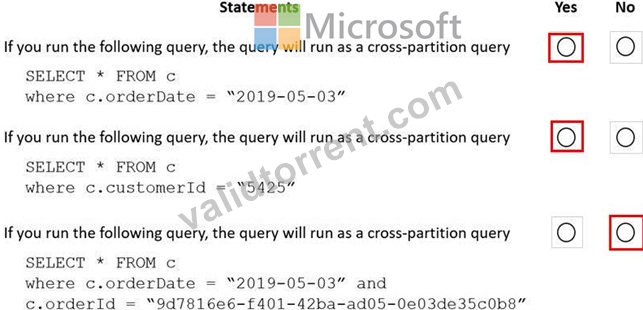
NEW QUESTION # 100
You have the Azure Cosmos DB for NoSQL containers shown in the following table.
You have the items shown in the following table.
When will each item expire? To answer, select the appropriate options in the answer area.
NOTE: Each correct selection is worth one point.
Answer:
Explanation:
Explanation:
NEW QUESTION # 101
Your company develops an application named App1 that uses the Azure Cosmos DB SDK and the Eventual consistency level.
App1 queries an Azure Cosmos DB for NoSQL account named account!
You need to identify which consistency level to assign to App1 to meet the following requirements:
* Maximize the throughput of the queries generated by App1 without increasing the number of request units currently used by the queries.
* Provide the highest consistency guarantees.
Which consistency level should you identify?
- A. Consistent Prefix
- B. Session
- C. Strong
- D. Bounded Staleness
Answer: C
NEW QUESTION # 102
You are troubleshooting the current issues caused by the application updates.
Which action can address the application updates issue without affecting the functionality of the application?
- A. Add a custom indexing policy to the con-product container.
- B. Set the default consistency level of account1 to bounded staleness.
- C. Enable time to live for the con-product container.
- D. Set the default consistency level of account1 to strong.
Answer: B
Explanation:
Bounded staleness is frequently chosen by globally distributed applications that expect low write latencies but require total global order guarantee. Bounded staleness is great for applications featuring group collaboration and sharing, stock ticker, publish-subscribe/queueing etc.
Scenario: Application updates in con-product frequently cause HTTP status code 429 "Too many requests". You discover that the 429 status code relates to excessive request unit (RU) consumption during the updates.
Reference:
https://docs.microsoft.com/en-us/azure/cosmos-db/consistency-levels
NEW QUESTION # 103
You have an Azure Cosmos DB Core (SQL) API account named storage1 that uses provisioned throughput capacity mode.
The storage1 account contains the databases shown in the following table.
The databases contain the containers shown in the following table.
For each of the following statements, select Yes if the statement is true. Otherwise, select No.
NOTE: Each correct selection is worth one point.
Answer:
Explanation:
Explanation
Box 1: No
Four containers with 1000 RU/s each.
Box 2: No
Max 8000 RU/s for db2. 8 containers, so 1000 RU/s for each container.
Box 3: Yes
Max 8000 RU/s for db2. 8 containers, so 1000 RU/s for each container. Can very well add an additional container.
Reference:
https://docs.microsoft.com/en-us/azure/cosmos-db/plan-manage-costs
https://azure.microsoft.com/en-us/pricing/details/cosmos-db/
NEW QUESTION # 104
Note: This question is part of a series of questions that present the same scenario. Each question in the series contains a unique solution that might meet the stated goals. Some question sets might have more than one correct solution, while others might not have a correct solution.
After you answer a question in this section, you will NOT be able to return to it. As a result, these questions will not appear in the review screen.
You have a container named container1 in an Azure Cosmos DB Core (SQL) API account.
You need to make the contents of container1 available as reference data for an Azure Stream Analytics job.
Solution: You create an Azure Synapse pipeline that uses Azure Cosmos DB Core (SQL) API as the input and Azure Blob Storage as the output.
Does this meet the goal?
- A. Yes
- B. No
Answer: B
Explanation:
Instead create an Azure function that uses Azure Cosmos DB Core (SQL) API change feed as a trigger and Azure event hub as the output.
The Azure Cosmos DB change feed is a mechanism to get a continuous and incremental feed of records from an Azure Cosmos container as those records are being created or modified. Change feed support works by listening to container for any changes. It then outputs the sorted list of documents that were changed in the order in which they were modified.
The following diagram represents the data flow and components involved in the solution:
Reference: https://docs.microsoft.com/en-us/azure/cosmos-db/sql/changefeed-ecommerce-solution
NEW QUESTION # 105
You plan to implement con-iot1 and con-iot2.
You need to configure the default Time to Live setting for each container. The solution must meet the loT telemetry requirements.
What should you configure? To answer, select the appropriate options in the answer NOTE: Each correct selection is worth one point.
Answer:
Explanation:
Explanation:
Box 1 =On (no default)
For con-iot1, you need to configure the default TTL setting to On (no default), which means that items in this container do not expire by default, but you can override the TTL value on a per-item basis. This meets the requirement of retaining all telemetry data unless overridden1.
Box 2 = On (3600 seconds)
For con-iot2, you need to configure the default TTL setting to On (3600 seconds), which means that items in this container will expire 3600 seconds (one hour) after their last modified time. This meets the requirement of deleting all telemetry data older than one hour1.
NEW QUESTION # 106
You have a database named db1 in an Azure Cosmos DB for NoSQL account named account1. The db1 database has a manual throughput of 4,000 request units per second (RU/s).
You need to move db1 from manual throughput to autoscale throughput by using the Azure CLI. The solution must provide a minimum of 4,000 RU/s and a maximum of 40,000 RU/s.
How should you complete the CLI statements? To answer, select the appropriate options in the answer area.
NOTE: Each correct selection is worth one point.
Answer:
Explanation:
Explanation
Migrate
40000
According to the Azure CLI reference , you need to use the az cosmosdb sql database throughput migrate command to migrate the throughput of the SQL database between autoscale and manually provisioned. You also need to use the --throughput-type parameter to specify the type of throughput to migrate to, and the --max-throughput parameter to specify the maximum throughput resource can scale to (RU/s).
To complete the CLI statements, you should replace the missing values with:
* --throughput-type autoscale
* --max-throughput 40000
The final command should look like this:
az cosmosdb sql database throughput migrate \
--account-name account1 \
--name db1 \
--resource-group rg1 \
--throughput-type autoscale \
--max-throughput 40000
NEW QUESTION # 107
......
Microsoft DP-420 exam is a challenging certification that requires extensive knowledge and hands-on experience in designing and implementing cloud-native applications using Azure Cosmos DB. To pass DP-420 exam, candidates need to have a thorough understanding of the different concepts and technologies associated with cloud-native application development, including data partitioning, global distribution, server-side programming models, and query optimization.
DP-420 Practice Test Pdf Exam Material: https://www.validtorrent.com/DP-420-valid-exam-torrent.html
DP-420 Answers DP-420 Free Demo Are Based On The Real Exam: https://drive.google.com/open?id=1vHO7gGp0lYOhuDuZGboxsAisXvI3iTq1