

[May 14, 2026] NetSec-Analyst PDF Dumps is essential on your NetSec-Analyst Exam Questions Certain Success!
NetSec-Analyst PDF Questions - Perfect Prospect To Go With NetSec-Analyst Practice Exam
NEW QUESTION # 21
Based on the screenshot what is the purpose of the group in User labelled ''it"?
- A. Allows users in group "DMZ" lo access IT applications
- B. Allows "any" users to access servers in the DMZ zone
- C. Allows users in group "it" to access IT applications
- D. Allows users to access IT applications on all ports
Answer: C
NEW QUESTION # 22
A Palo Alto Networks administrator needs to investigate a potential data exfiltration attempt. They have identified several 'data-filtering' logs in the Log Viewer indicating sensitive data patterns being transmitted outbound. The Incidents and Alerts page shows a correlated alert for 'High Severity DLP Violation'. Which of the following data points from the Log Viewer and Incidents page are MOST critical for initial forensic analysis and response?
- A. Log Viewer: 'Source IP', 'Destination IP', 'Application', 'User', 'Data Filter Profile', 'Action'. Incidents Page: 'Alert ID', 'Description', 'Correlated Events', 'Recommended Action'.
- B. Log Viewer: 'Time', 'Source IP', 'Destination IP', 'Application', 'User'. Incidents Page: 'Alert ID', 'Status'.
- C. Log Viewer: 'Protocol', 'Source Port', 'Destination Port'. Incidents Page: 'MITRE ATT&CK Tactic', 'MITRE ATT&CK Technique'.
- D. Log Viewer: 'Session ID', 'Byte Count', 'Ingress Zone'. Incidents Page: 'Assignee', 'Creation Time'.
- E. Log Viewer: 'Severity', 'Rule Name', 'Interface'. Incidents Page: 'Description', 'Affected Assets'.
Answer: A
Explanation:
For data exfiltration, detailed contextual information is vital. From the Log Viewer, 'Source IP' (who initiated), 'Destination IP' (where data went), 'Application' (how it went, e.g., FTP, HTTP, email), 'User' (which user account), 'Data Filter Profile' (which specific DLP profile was triggered), and 'Action' (was it blocked, allowed with alert?) are paramount. On the Incidents and Alerts page, the 'Alert ID' for tracking, 'Description' for a summary, 'Correlated Events' for broader context (e.g., preceding reconnaissance), and 'Recommended Action' (if provided by the system) are critical for immediate response and further investigation. Options A, B, D, and E provide some useful data but lack the comprehensive set required for initial forensic analysis of data exfiltration.
NEW QUESTION # 23
Given the image, which two options are true about the Security policy rules. (Choose two.)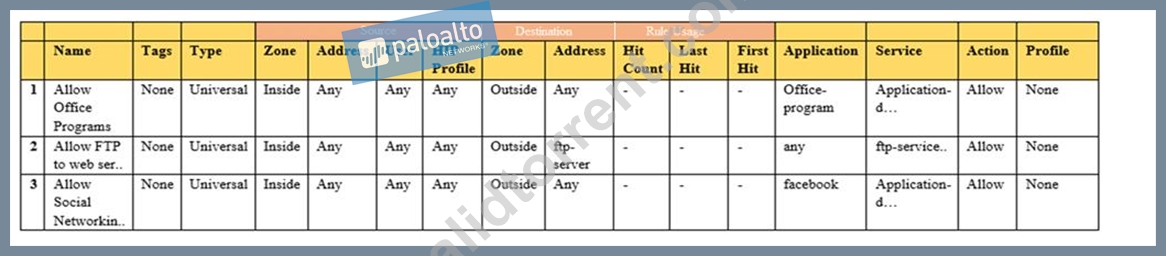
- A. In the Allow Social Networking rule, allows all of Facebook's functions
- B. The Allow Office Programs rule is using an Application Filter
- C. The Allow Office Programs rule is using an Application Group
- D. In the Allow FTP to web server rule, FTP is allowed using App-ID
Answer: A,B
Explanation:
In the Allow FTP to web server rule, FTP is allowed using port based rule and not APP-ID.
NEW QUESTION # 24
Which rule type is appropriate for matching traffic occurring within a specified zone?
- A. Shadowed
- B. Interzone
- C. Universal
- D. Intrazone
Answer: D
NEW QUESTION # 25
A large-scale deployment uses Panorama to manage hundreds of Palo Alto Networks firewalls. An External Dynamic List (EDL) for 'IP Address' type is centrally configured on Panorama, pointing to an internal threat intelligence server. Which of the following statements accurately describes the operational flow and considerations when this EDL is applied to Security Policy rules pushed from Panorama to the managed firewalls?
- A. Each managed firewall independently fetches the EDL content directly from the threat intelligence server based on its configured refresh interval, and Panorama only distributes the EDL object definition.
- B. Only firewalls with Panorama's 'Threat Prevention' subscription can utilize EDLs configured on Panorama.
- C. EDLs configured on Panorama can only be used in Pre-Rulebase or Post-Rulebase policies, not in shared rulebases.
- D. Panorama fetches the EDL content and pushes the entire list to each firewall during a policy commit.
- E. If the threat intelligence server is unreachable, Panorama will cache the last known good list and push it to all firewalls.
Answer: A
Explanation:
This question tests the understanding of how Panorama manages dynamic content. Option B (Correct): Panorama manages the definition of the EDL (its name, type, source URL, refresh interval, etc.) and pushes this definition to managed firewalls. However, each individual firewall is responsible for fetching the actual content of the EDL directly from the configured source URL. This design distributes the load and ensures firewalls have the most up-to-date lists even if Panorama is temporarily unavailable. Option A is incorrect; Panorama does not typically fetch and push the content of EDLs. Option C is incorrect; EDL functionality is core and not tied to specific subscriptions like Threat Prevention. Option D is incorrect; EDLs can be used in any rulebase (shared, device-group, template). Option E is incorrect; Panorama does not cache EDL content for pushing to firewalls if the source is unreachable; the individual firewalls attempt to fetch and will log errors if they fail.
NEW QUESTION # 26
A company is implementing a new BYOD policy and needs to ensure that mobile devices accessing internal resources are protected from known and unknown malware. They have deployed a Palo Alto Networks firewall with WildFire subscriptions. Which configuration steps are essential to leverage WildFire for comprehensive malware analysis and prevention specifically for BYOD traffic, assuming a security policy rule already exists for BYOD access?
- A. Modify the existing Anti-Spyware profile applied to BYOD traffic to include WildFire signature updates. Configure a Data Filtering profile to detect and block suspicious file transfers from BYOD devices. No separate WildFire Analysis profile is needed.
- B. Create a WildFire Analysis profile configured to 'Block' for 'PE' files and 'upload' for all other file types. Apply this profile within a Security Profile Group along with an Antivirus profile set to 'reset-both' for critical severity threats. Ensure the Security Policy rule's action is 'allow'.
- C. Create a WildFire Analysis profile with a 'Forward' action for 'PE' files. Create a File Blocking profile to block all 'unknown-file-types'. Group these into a new Security Profile Group and apply it to the BYOD security policy rule. Ensure the firewall has connectivity to the WildFire cloud or appliance.
- D. Enable WildFire analysis within the existing URL Filtering profile applied to the BYOD security policy. Configure a File Blocking profile to block all executable files, and enable WildFire submission for 'all' file types.
- E. Create a new WildFire Analysis profile. Set the 'File Types' to 'all' and 'Action' to 'upload' for known good and bad files. Attach this WildFire Analysis profile directly to the BYOD security policy rule. Ensure Antivirus and Anti-Spyware profiles are also applied.
Answer: B
Explanation:
Option E provides the most robust and accurate WildFire configuration for BYOD, emphasizing both prevention and analysis. Setting 'Block' for PE files directly prevents execution of potentially malicious binaries, while 'upload' for other types ensures comprehensive analysis. Pairing this with an Antivirus profile offers signature-based protection. The 'reset-both' action for Antivirus is a strong preventive measure. It's crucial that the security policy rule's action is 'allow' for traffic to be inspected by profiles. Option B is incorrect as 'upload' for known bad files isn't the primary action; blocking is preferred. Option A incorrectly implies WildFire is configured within URL Filtering for file analysis. Option C misunderstands WildFire's integration. Option D's 'Forward' for PE files doesn't provide immediate blocking, and 'unknown-file-types' is too generic for effective file blocking.
NEW QUESTION # 27
An analyst notices that a security rule intended to block a specific application is being bypassed. Upon investigation, the analyst finds that the traffic is matching a rule higher in the list. Which tool provides a visual "Shadowing" check to identify rules that will never be hit?
- A. Policy Optimizer
- B. ACC (Application Command Center)
- C. Config Audit
- D. Rule Usage Filter
Answer: A
Explanation:
Comprehensive and Detailed 150 to 250 words of Explanation From Palo Alto Networks Network Security Analyst Knowledge:
Maintaining a clean and effective security policy is a primary objective for a Network Security Analyst. Over time, rulebases can become cluttered with redundant or "shadowed" rules. Policy Optimizer is the specialized tool within the PAN-OS web interface (and Strata Cloud Manager) designed to solve this problem.
The Policy Optimizer provides a "Rule Usage" and "No App-ID" view that highlights rules that have not seen traffic over a specific period or rules that are redundant. If a rule is "shadowed"-meaning a more general rule above it is capturing all the intended traffic-the Policy Optimizer helps the analyst identify the conflict. This allows the analyst to either move the specific rule higher in the list or consolidate the two rules into one. By resolving these conflicts, the analyst ensures that the intended security posture is actually enforced and that the firewall's performance is optimized by reducing the number of rules the data plane must evaluate for every session.
NEW QUESTION # 28
Based on the show security policy rule would match all FTP traffic from the inside zone to the outside zone?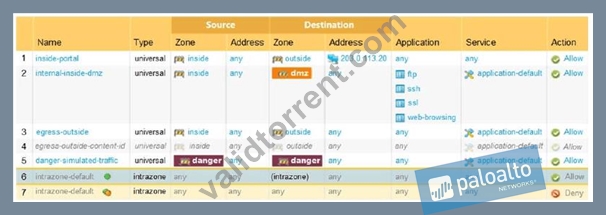
- A. engress outside
- B. intercone-default
- C. internal-inside-dmz
- D. inside-portal
Answer: A
NEW QUESTION # 29
Given the Cyber-Attack Lifecycle diagram, identify the stage in which the attacker can initiate malicious code against a targeted machine.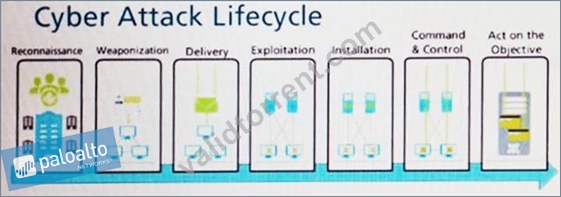
- A. Reconnaissance
- B. Exploitation
- C. Act on Objective
- D. Installation
Answer: B
NEW QUESTION # 30 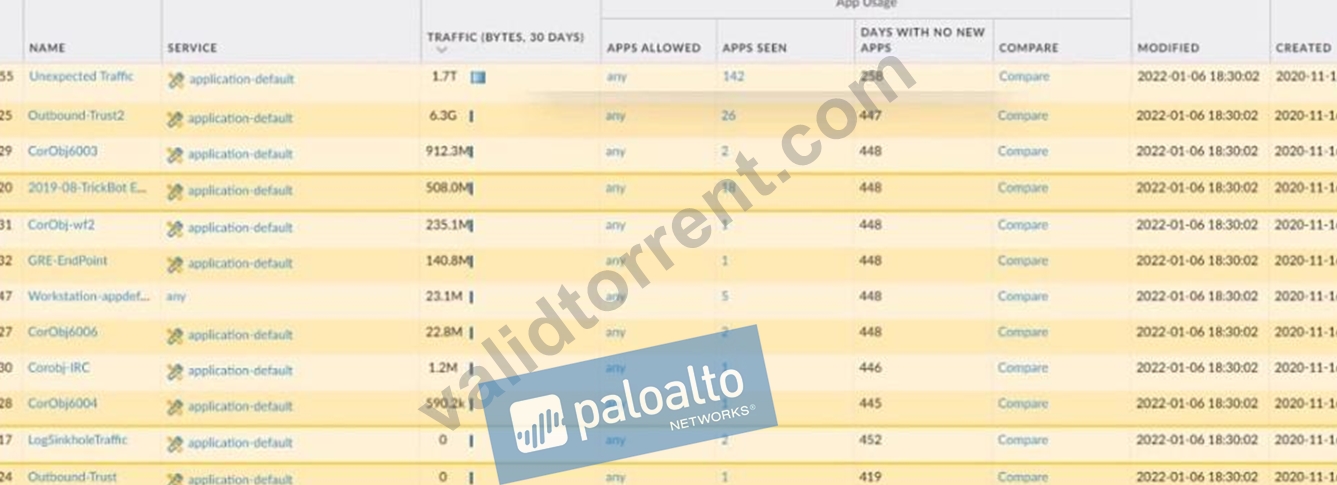
An administrator is updating Security policy to align with best practices.
Which Policy Optimizer feature is shown in the screenshot below?
- A. Rules without App Controls
- B. New App Viewer
- C. Rule Usage
- D. Unused Unused Apps
Answer: C
NEW QUESTION # 31
A security architect is designing an automated incident response playbook within their Security Orchestration, Automation, and Response (SOAR) platform. This playbook needs to interact with Strata Cloud Manager (SCM) to perform actions like blocking malicious IPs, quarantining compromised devices, and retrieving firewall logs. Which of the following Python code snippets demonstrates the correct initial step to authenticate and interact with SCM's API for such operations?
- A.

- B.

- C.
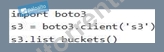
- D.

- E.

Answer: A
Explanation:
SCM primarily utilizes OAuth 2.0 for API authentication, typically with client credentials (client ID and client secret) for machine-to- machine interaction. Option A demonstrates the correct Python code to obtain an access token from SCM's OAuth 2.0 token endpoint. This access token is then used in subsequent API requests to authorize operations. Options B and C are for SSH/CLI interactions, Option D is for AWS S3, and Option E represents an older XML API authentication method which is not the primary or recommended method for SCM's modern REST API.
NEW QUESTION # 32
A publicly accessible web application is frequently targeted by HTTP GET floods and slow-read attacks. The existing DoS protection profile on the Palo Alto Networks firewall is configured with generic thresholds, leading to false positives and occasional legitimate user disruptions. The security team wants to refine the DoS protection to specifically counter these HTTP-based attacks while minimizing impact on legitimate users. Which of the following combinations of DoS protection profile settings and their application would be most effective?
- A. Implement 'Session Based Attack Protection' for 'HTTP Flood' with 'Max Concurrent Sessions' and 'Session Rate' thresholds, and use 'Action: Block' for sources exceeding limits.
- B. Enable 'HTTP Flood' protection with 'Per-Request Rate' and 'Per-Source IP Rate' thresholds, combined with 'Per-URL Rate' for critical URLs, and set 'Action: Drop' for exceeding thresholds.
- C. Both B and D.
- D. Configure 'HTTP Flood' protection with a 'Per-Request Rate' and 'Per-Source IP Rate' threshold, setting 'Action: Syn-Cookie' to challenge suspicious HTTP requests.
- E. Utilize 'Slow HTTP Protection' with 'Client Header Timeout' and 'Client Read Timeout' set to aggressive values (e.g., 5 seconds), and 'Action: Reset' for non-compliant sessions.
Answer: C
Explanation:
The scenario describes two distinct HTTP-based attacks: GET floods and slow-read attacks. HTTP GET floods are best mitigated by rate-limiting on a per-request, per-source IP, and potentially per-URL basis, making 'HTTP Flood' protection with 'Per-Request Rate', 'Per-Source IP Rate', and 'Per-URL Rate' (Option B) highly effective. Slow-read attacks, where an attacker slowly consumes the response to tie up server resources, are specifically addressed by 'Slow HTTP Protection' using 'Client Header Timeout' and 'Client Read Timeout' (Option D). Combining both B and D provides comprehensive protection against both types of HTTP attacks mentioned, making E the correct choice.
NEW QUESTION # 33
Where in Panorama Would Zone Protection profiles be configured?
- A. Shared
- B. Device Groups
- C. Templates
- D. Panorama tab
Answer: C
Explanation:
https://docs.paloaltonetworks.com/panorama/9-1/panorama-admin/manage-firewalls/use-case-configure-firewalls-using-panorama/set-up-your-centralized-configuration-and-policies/use-templates-to-administer-a-base-configuration
NEW QUESTION # 34
Which three Ethernet interface types are configurable on the Palo Alto Networks firewall? (Choose three.)
- A. Tap
- B. Static
- C. Layer 3
- D. Virtual Wire
- E. Dynamic
Answer: A,C,D
Explanation:
Palo Alto Networks firewalls support three types of Ethernet interfaces that can be configured on the firewall:
virtual wire, tap, and layer 31. These interface types determine how the firewall processes traffic and applies security policies. Some of the characteristics of these interface types are:
Virtual Wire: A virtual wire interface allows the firewall to transparently pass traffic between two network segments without modifying the packets or affecting the routing. The firewall can still apply security policies and inspect the traffic based on the source and destination zones of the virtual wire2.
Tap: A tap interface allows the firewall to passively monitor traffic from a network switch or router without affecting the traffic flow. The firewall can only receive traffic from a tap interface and cannot send traffic out of it. The firewall can apply security policies and inspect the traffic based on the source and destination zones of the tap interface3.
Layer 3: A layer 3 interface allows the firewall to act as a router and participate in the network routing. The firewall can send and receive traffic from a layer 3 interface and apply security policies and inspect the traffic based on the source and destination IP addresses and zones of the interface4.
References: Ethernet Interface Types, Virtual Wire Interfaces, Tap Interfaces, Layer 3 Interfaces, Updated Certifications for PAN-OS 10.1, [Palo Alto Networks Certified Network Security Administrator (PAN-OS
10.0)] or [Palo Alto Networks Certified Network Security Administrator (PAN-OS 10.0)].
NEW QUESTION # 35
Which action related to App-ID updates will enable a security administrator to view the existing security policy rule that matches new application signatures?
- A. Pre-analyze
- B. Review App Matches
- C. Review Apps
- D. Review Policies
Answer: D
Explanation:
References:
https://docs.paloaltonetworks.com/pan-os/9-0/pan-os-admin/app-id/manage-new-app-ids-introduced- incontent-releases/review-new-app-id-impact-on- existing-policy-rules
NEW QUESTION # 36
......
Palo Alto Networks NetSec-Analyst Exam Syllabus Topics:
| Topic | Details |
|---|---|
| Topic 1 |
|
| Topic 2 |
|
| Topic 3 |
|
| Topic 4 |
|
NetSec-Analyst Exam with Accurate Palo Alto Networks Network Security Analyst PDF Questions: https://www.validtorrent.com/NetSec-Analyst-valid-exam-torrent.html
True Palo Alto Networks Exam Extraordinary Practice For the NetSec-Analyst Exam: https://drive.google.com/open?id=1XU1YlJ9Gecib_sSM1Bm2PQj_TTsgDpC6