

2024 Correct Practice Tests of Professional-Machine-Learning-Engineer Dumps with Practice Exam
Certification Sample Questions of Professional-Machine-Learning-Engineer Dumps With 100% Exam Passing Guarantee
NEW QUESTION # 85
You need to analyze user activity data from your company's mobile applications. Your team will use BigQuery for data analysis, transformation, and experimentation with ML algorithms. You need to ensure real-time ingestion of the user activity data into BigQuery. What should you do?
- A. Run a Dataflow streaming job to ingest the data into BigQuery.
- B. Configure Pub/Sub and a Dataflow streaming job to ingest the data into BigQuery,
- C. Configure Pub/Sub to stream the data into BigQuery.
- D. Run an Apache Spark streaming job on Dataproc to ingest the data into BigQuery.
Answer: C
NEW QUESTION # 86
You work for a social media company. You want to create a no-code image classification model for an iOS mobile application to identify fashion accessories You have a labeled dataset in Cloud Storage You need to configure a training workflow that minimizes cost and serves predictions with the lowest possible latency What should you do?
- A. Train the model by using AutoML Edge and export it as a Core ML model Configure your mobile application to use the mlmodel file directly.
- B. Train the model by using AutoML Edge and export the model as a TFLite model Configure your mobile application to use the tflite file directly
- C. Train the model by using AutoML, and register the model in Vertex Al Model Registry Configure your mobile application to send batch requests during prediction.
- D. Train the model by using AutoML, and expose the model as a Vertex Al endpoint Configure your mobile application to invoke the endpoint during prediction.
Answer: A
NEW QUESTION # 87
A data scientist has developed a machine learning translation model for English to Japanese by using Amazon SageMaker's built-in seq2seq algorithm with 500,000 aligned sentence pairs. While testing with sample sentences, the data scientist finds that the translation quality is reasonable for an example as short as five words. However, the quality becomes unacceptable if the sentence is 100 words long.
Which action will resolve the problem?
- A. Change preprocessing to use n-grams.
- B. Choose a different weight initialization type.
- C. Adjust hyperparameters related to the attention mechanism.
- D. Add more nodes to the recurrent neural network (RNN) than the largest sentence's word count.
Answer: D
NEW QUESTION # 88
You have deployed multiple versions of an image classification model on Al Platform. You want to monitor the performance of the model versions overtime. How should you perform this comparison?
- A. Compare the mean average precision across the models using the Continuous Evaluation feature
- B. Compare the loss performance for each model on the validation data
- C. Compare the receiver operating characteristic (ROC) curve for each model using the What-lf Tool
- D. Compare the loss performance for each model on a held-out dataset.
Answer: A
Explanation:
https://cloud.google.com/ai-platform/prediction/docs/continuous-evaluation/view-metrics
NEW QUESTION # 89
A Data Scientist needs to create a serverless ingestion and analytics solution for high-velocity, real-time streaming data.
The ingestion process must buffer and convert incoming records from JSON to a query-optimized, columnar format without data loss. The output datastore must be highly available, and Analysts must be able to run SQL queries against the data and connect to existing business intelligence dashboards.
Which solution should the Data Scientist build to satisfy the requirements?
- A. Use Amazon Kinesis Data Analytics to ingest the streaming data and perform real-time SQL queries to convert the records to Apache Parquet before delivering to Amazon S3. Have the Analysts query the data directly from Amazon S3 using Amazon Athena and connect to BI tools using the Athena Java Database Connectivity (JDBC) connector.
- B. Write each JSON record to a staging location in Amazon S3. Use the S3 Put event to trigger an AWS Lambda function that transforms the data into Apache Parquet or ORC format and inserts it into an Amazon RDS PostgreSQL database. Have the Analysts query and run dashboards from the RDS database.
- C. Create a schema in the AWS Glue Data Catalog of the incoming data format. Use an Amazon Kinesis Data Firehose delivery stream to stream the data and transform the data to Apache Parquet or ORC format using the AWS Glue Data Catalog before delivering to Amazon S3. Have the Analysts query the data directly from Amazon S3 using Amazon Athena, and connect to BI tools using the Athena Java Database Connectivity (JDBC) connector.
- D. Write each JSON record to a staging location in Amazon S3. Use the S3 Put event to trigger an AWS Lambda function that transforms the data into Apache Parquet or ORC format and writes the data to a processed data location in Amazon S3. Have the Analysts query the data directly from Amazon S3 using Amazon Athena, and connect to BI tools using the Athena Java Database Connectivity (JDBC) connector.
Answer: C
Explanation:
Explanation/Reference:
NEW QUESTION # 90
You are building an ML model to predict trends in the stock market based on a wide range of factors. While exploring the data, you notice that some features have a large range. You want to ensure that the features with the largest magnitude don't overfit the model. What should you do?
- A. Apply a principal component analysis (PCA) to minimize the effect of any particular feature.
- B. Use a binning strategy to replace the magnitude of each feature with the appropriate bin number.
- C. Standardize the data by transforming it with a logarithmic function.
- D. Normalize the data by scaling it to have values between 0 and 1.
Answer: D
Explanation:
The best option to ensure that the features with the largest magnitude don't overfit the model is to normalize the data by scaling it to have values between 0 and 1. This is also known as min-max scaling or feature scaling, and it can reduce the variance and skewness of the data, as well as improve the numerical stability and convergence of the model. Normalizing the data can also make the model less sensitive to the scale of the features, and more focused on the relative importance of each feature. Normalizing the data can be done using various methods, such as dividing each value by the maximum value, subtracting the minimum value and dividing by the range, or using the sklearn.preprocessing.MinMaxScaler function in Python.
The other options are not optimal for the following reasons:
* A. Standardizing the data by transforming it with a logarithmic function is not a good option, as it can distort the distribution and relationship of the data, and introduce bias and errors. Moreover, the logarithmic function is not defined for negative or zero values, which can limit its applicability and cause problems for the model.
* B. Applying a principal component analysis (PCA) to minimize the effect of any particular feature is not a good option, as it can reduce the interpretability and explainability of the data and the model. PCA is a dimensionality reduction technique that transforms the data into a new set of orthogonal features that capture the most variance in the data. However, these new features are not directly related to the original features, and can lose some information and meaning in the process. Moreover, PCA can be computationally expensive and complex, and may not be necessary for the problem at hand.
* C. Using a binning strategy to replace the magnitude of each feature with the appropriate bin number is not a good option, as it can lose the granularity and precision of the data, and introduce noise and outliers. Binning is a discretization technique that groups the continuous values of a feature into a finite number of bins or categories. However, this can reduce the variability and diversity of the data, and create artificial boundaries and gaps that may not reflect the true nature of the data. Moreover, binning can be arbitrary and subjective, and depend on the choice of the bin size and number.
References:
* Professional ML Engineer Exam Guide
* Preparing for Google Cloud Certification: Machine Learning Engineer Professional Certificate
* Google Cloud launches machine learning engineer certification
* Feature Scaling for Machine Learning: Understanding the Difference Between Normalization vs.
Standardization
* sklearn.preprocessing.MinMaxScaler documentation
* Principal Component Analysis Explained Visually
* Binning Data in Python
NEW QUESTION # 91
You work for a large technology company that wants to modernize their contact center. You have been asked to develop a solution to classify incoming calls by product so that requests can be more quickly routed to the correct support team. You have already transcribed the calls using the Speech-to-Text API. You want to minimize data preprocessing and development time. How should you build the model?
- A. Build a custom model to identify the product keywords from the transcribed calls, and then run the keywords through a classification algorithm
- B. Use the Cloud Natural Language API to extract custom entities for classification
- C. Use the Al Platform Training built-in algorithms to create a custom model
- D. Use AutoML Natural Language to extract custom entities for classification
Answer: C
NEW QUESTION # 92
A Machine Learning Specialist deployed a model that provides product recommendations on a company's website. Initially, the model was performing very well and resulted in customers buying more products on average. However, within the past few months, the Specialist has noticed that the effect of product recommendations has diminished and customers are starting to return to their original habits of spending less.
The Specialist is unsure of what happened, as the model has not changed from its initial deployment over a year ago.
Which method should the Specialist try to improve model performance?
- A. The model's hyperparameters should be periodically updated to prevent drift.
- B. The model should be periodically retrained from scratch using the original data while adding a regularization term to handle product inventory changes
- C. The model needs to be completely re-engineered because it is unable to handle product inventory changes.
- D. The model should be periodically retrained using the original training data plus new data as product inventory changes.
Answer: D
NEW QUESTION # 93
While monitoring your model training's GPU utilization, you discover that you have a native synchronous implementation. The training data is split into multiple files. You want to reduce the execution time of your input pipeline. What should you do?
- A. Add parallel interleave to the pipeline
- B. Add caching to the pipeline
- C. Increase the network bandwidth
- D. Increase the CPU load
Answer: D
NEW QUESTION # 94
You want to rebuild your ML pipeline for structured data on Google Cloud. You are using PySpark to conduct data transformations at scale, but your pipelines are taking over 12 hours to run. To speed up development and pipeline run time, you want to use a serverless tool and SQL syntax. You have already moved your raw data into Cloud Storage. How should you build the pipeline on Google Cloud while meeting the speed and processing requirements?
- A. Use Data Fusion's GUI to build the transformation pipelines, and then write the data into BigQuery
- B. Convert your PySpark into SparkSQL queries to transform the data and then run your pipeline on Dataproc to write the data into BigQuery.
- C. Ingest your data into Cloud SQL convert your PySpark commands into SQL queries to transform the data, and then use federated queries from BigQuery for machine learning
- D. Ingest your data into BigQuery using BigQuery Load, convert your PySpark commands into BigQuery SQL queries to transform the data, and then write the transformations to a new table
Answer: B
NEW QUESTION # 95
You developed a Vertex Al ML pipeline that consists of preprocessing and training steps and each set of steps runs on a separate custom Docker image Your organization uses GitHub and GitHub Actions as CI/CD to run unit and integration tests You need to automate the model retraining workflow so that it can be initiated both manually and when a new version of the code is merged in the main branch You want to minimize the steps required to build the workflow while also allowing for maximum flexibility How should you configure the CI/CD workflow?
- A. Trigger GitHub Actions to run the tests build custom Docker images push the images to Artifact Registry, and launch the pipeline in Vertex Al Pipelines.
- B. Trigger a Cloud Build workflow to run tests build custom Docker images, push the images to Artifact Registry and launch the pipeline in Vertex Al Pipelines.
- C. Trigger GitHub Actions to run the tests launch a job on Cloud Run to build custom Docker images push the images to Artifact Registry and launch the pipeline in Vertex Al Pipelines.
- D. Trigger GitHub Actions to run the tests launch a Cloud Build workflow to build custom Dicker images, push the images to Artifact Registry, and launch the pipeline in Vertex Al Pipelines.
Answer: A
NEW QUESTION # 96
You recently trained an XGBoost model on tabular data You plan to expose the model for internal use as an HTTP microservice After deployment you expect a small number of incoming requests. You want to productionize the model with the least amount of effort and latency. What should you do?
- A. Deploy the model to BigQuery ML by using CREATE model with the
BOOSTED-THREE-REGRESSOR statement and invoke the BigQuery API from the microservice. - B. Build a Flask-based app Package the app in a custom container on Vertex Al and deploy it to Vertex Al Endpoints.
- C. Use a prebuilt XGBoost Vertex container to create a model and deploy it to Vertex Al Endpoints.
- D. Build a Flask-based app Package the app in a Docker image and deploy it to Google Kubernetes Engine in Autopilot mode.
Answer: C
Explanation:
XGBoost is a popular open-source library that provides a scalable and efficient implementation of gradient boosted trees. You can use XGBoost to train a classification or regression model on tabular data. You can also use Vertex AI to productionize the model and expose it for internal use as an HTTP microservice. Vertex AI is a service that allows you to create and train ML models using Google Cloud technologies. You can use a prebuilt XGBoost Vertex container to create a model and deploy it to Vertex AI Endpoints. A prebuilt Vertex container is a container image that contains the dependencies and libraries needed to run a specific ML framework, such as XGBoost. You can use a prebuilt Vertex container to simplify the model creation and deployment process, without having to build your own custom container. Vertex AI Endpoints is a service that allows you to serve your ML models online and scale them automatically. You can use Vertex AI Endpoints to deploy the model from the prebuilt Vertex container and expose it as an HTTP microservice. You can also configure the endpoint to handle a small number of incoming requests, and optimize the latency and cost of serving the model. By using a prebuilt XGBoost Vertex container and Vertex AI Endpoints, you can productionize the model with the least amount of effort and latency. References:
* XGBoost documentation
* Vertex AI documentation
* Prebuilt Vertex container documentation
* Vertex AI Endpoints documentation
* Preparing for Google Cloud Certification: Machine Learning Engineer Professional Certificate
NEW QUESTION # 97
Your organization's call center has asked you to develop a model that analyzes customer sentiments in each call. The call center receives over one million calls daily, and data is stored in Cloud Storage. The data collected must not leave the region in which the call originated, and no Personally Identifiable Information (Pll) can be stored or analyzed. The data science team has a third-party tool for visualization and access which requires a SQL ANSI-2011 compliant interface. You need to select components for data processing and for analytics. How should the data pipeline be designed?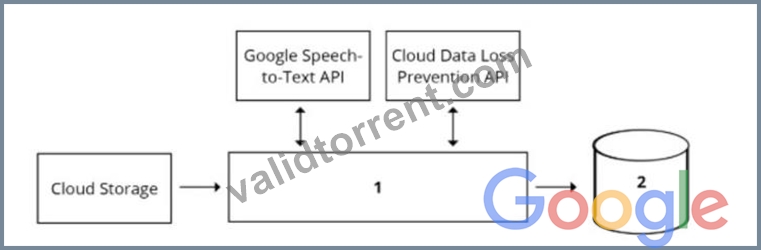
- A. 1 = Dataflow, 2 = BigQuery
- B. 1 = Dataflow, 2 = Cloud SQL
- C. 1 = Cloud Function, 2 = Cloud SQL
- D. 1 = Pub/Sub, 2 = Datastore
Answer: A
Explanation:
https://github.com/GoogleCloudPlatform/dataflow-contact-center-speech-analysis
NEW QUESTION # 98
You need to build classification workflows over several structured datasets currently stored in BigQuery. Because you will be performing the classification several times, you want to complete the following steps without writing code: exploratory data analysis, feature selection, model building, training, and hyperparameter tuning and serving. What should you do?
- A. Use Al Platform Notebooks to run the classification model with pandas library
- B. Use Al Platform to run the classification model job configured for hyperparameter tuning
- C. Run a BigQuery ML task to perform logistic regression for the classification
- D. Configure AutoML Tables to perform the classification task
Answer: C
Explanation:
BigQuery ML supports supervised learning with the logistic regression model type.
NEW QUESTION # 99
You are deploying a new version of a model to a production Vertex Al endpoint that is serving traffic You plan to direct all user traffic to the new model You need to deploy the model with minimal disruption to your application What should you do?
- A. 1 Create a new endpoint.
2 Create a new model Set it as the default version Upload the model to Vertex Al Model Registry.
3. Deploy the new model to the new endpoint.
4 Update Cloud DNS to point to the new endpoint - B. 1, Create a new model Set it as the default version Upload the model to Vertex Al Model Registry
2 Deploy the new model to the existing endpoint - C. 1 Create a new model Set the parentModel parameter to the model ID of the currently deployed model Upload the model to Vertex Al Model Registry.
2 Deploy the new model to the existing endpoint and set the new model to 100% of the traffic. - D. 1. Create a new endpoint.
2. Create a new model Set the parentModel parameter to the model ID of the currently deployed model and set it as the default version Upload the model to Vertex Al Model Registry
3. Deploy the new model to the new endpoint and set the new model to 100% of the traffic
Answer: C
Explanation:
The best option for deploying a new version of a model to a production Vertex AI endpoint that is serving traffic, directing all user traffic to the new model, and deploying the model with minimal disruption to your application, is to create a new model, set the parentModel parameter to the model ID of the currently deployed model, upload the model to Vertex AI Model Registry, deploy the new model to the existing endpoint, and set the new model to 100% of the traffic. This option allows you to leverage the power and simplicity of Vertex AI to update your model version and serve online predictions with low latency. Vertex AI is a unified platform for building and deploying machine learning solutions on Google Cloud. Vertex AI can deploy a trained model to an online prediction endpoint, which can provide low-latency predictions for individual instances. A model is a resource that represents a machine learning model that you can use for prediction. A model can have one or more versions, which are different implementations of the same model. A model version can have different parameters, code, or data than another version of the same model. A model version can help you experiment and iterate on your model, and improve the model performance and accuracy. A parentModel parameter is a parameter that specifies the model ID of the model that the new model version is based on. A parentModel parameter can help you inherit the settings and metadata of the existing model, and avoid duplicating the model configuration. Vertex AI Model Registry is a service that can store and manage your machine learning models on Google Cloud. Vertex AI Model Registry can help you upload and organize your models, and track the model versions and metadata. An endpoint is a resource that provides the service endpoint (URL) you use to request the prediction. An endpoint can have one or more deployed models, which are instances of model versions that are associated with physical resources. A deployed model can help you serve online predictions with low latency, and scale up or down based on the traffic. By creating a new model, setting the parentModel parameter to the model ID of the currently deployed model, uploading the model to Vertex AI Model Registry, deploying the new model to the existing endpoint, and setting the new model to 100% of the traffic, you can deploy a new version of a model to a production Vertex AI endpoint that is serving traffic, direct all user traffic to the new model, and deploy the model with minimal disruption to your application1.
The other options are not as good as option C, for the following reasons:
* Option A: Creating a new endpoint, creating a new model, setting it as the default version, uploading the model to Vertex AI Model Registry, deploying the new model to the new endpoint, and updating Cloud DNS to point to the new endpoint would require more skills and steps than creating a new model, setting the parentModel parameter to the model ID of the currently deployed model, uploading the model to Vertex AI Model Registry, deploying the new model to the existing endpoint, and setting the new model to 100% of the traffic. Cloud DNS is a service that can provide reliable and scalable Domain Name System (DNS) services on Google Cloud. Cloud DNS can help you manage your DNS records, and resolve domain names to IP addresses. By updating Cloud DNS to point to the new endpoint, you can redirect the user traffic to the new endpoint, and avoid breaking the existing application. However, creating a new endpoint, creating a new model, setting it as the default version, uploading the model to Vertex AI Model Registry, deploying the new model to the new endpoint, and updating Cloud DNS to point to the new endpoint would require more skills and steps than creating a new model, setting the parentModel parameter to the model ID of the currently deployed model, uploading the model to Vertex AI Model Registry, deploying the new model to the existing endpoint, and setting the new model to
100% of the traffic. You would need to write code, create and configure the new endpoint, create and configure the new model, upload the model to Vertex AI Model Registry, deploy the model to the new endpoint, and update Cloud DNS to point to the new endpoint. Moreover, this option would create a new endpoint, which can increase the maintenance and management costs2.
* Option B: Creating a new endpoint, creating a new model, setting the parentModel parameter to the model ID of the currently deployed model and setting it as the default version, uploading the model to Vertex AI Model Registry, and deploying the new model to the new endpoint and setting the new model to 100% of the traffic would require more skills and steps than creating a new model, setting the parentModel parameter to the model ID of the currently deployed model, uploading the model to Vertex AI Model Registry, deploying the new model to the existing endpoint, and setting the new model to
100% of the traffic. A parentModel parameter is a parameter that specifies the model ID of the model that the new model version is based on. A parentModel parameter can help you inherit the settings and metadata of the existing model, and avoid duplicating the model configuration. A default version is a model version that is used for prediction when no other version is specified. A default version can help you simplify the prediction request, and avoid specifying the model version every time. By setting the parentModel parameter to the model ID of the currently deployed model and setting it as the default version, you can create a new model that is based on the existing model, and use it for prediction without specifying the model version. However, creating a new endpoint, creating a new model, setting the parentModel parameter to the model ID of the currently deployed model and setting it as the default version, uploading the model to Vertex AI Model Registry, and deploying the new model to the new endpoint and setting the new model to 100% of the traffic would require more skills and steps than creating a new model, setting the parentModel parameter to the model ID of the currently deployed
* model, uploading the model to Vertex AI Model Registry, deploying the new model to the existing endpoint, and setting the new model to 100% of the traffic. You would need to write code, create and configure the new endpoint, create and configure the new model, upload the model to Vertex AI Model Registry, and deploy the model to the new endpoint. Moreover, this option would create a new endpoint, which can increase the maintenance and management costs2.
* Option D: Creating a new model, setting it as the default version, uploading the model to Vertex AI Model Registry, and deploying the new model to the existing endpoint would not allow you to inherit the settings and metadata of the existing model, and could cause errors or poor performance. A default version is a model version that is used for prediction when no other version is specified. A default version can help you simplify the prediction request, and avoid specifying the model version every time.
By setting the new model as the default version, you can use the new model for prediction without specifying the model version. However, creating a new model, setting it as the default version, uploading the model to Vertex AI Model Registry, and deploying the new model to the existing endpoint would not allow you to inherit the settings and metadata of the existing model, and could cause errors or poor performance. You would need to write code, create and configure the new model, upload the model to Vertex AI Model Registry, and deploy the model to the existing endpoint. Moreover, this option would not set the parentModel parameter to the model ID of the currently deployed model, which could prevent you from inheriting the settings and metadata of the existing model, and cause inconsistencies or conflicts between the model versions2.
References:
* Preparing for Google Cloud Certification: Machine Learning Engineer, Course 3: Production ML Systems, Week 2: Serving ML Predictions
* Google Cloud Professional Machine Learning Engineer Exam Guide, Section 3: Scaling ML models in production, 3.1 Deploying ML models to production
* Official Google Cloud Certified Professional Machine Learning Engineer Study Guide, Chapter 6:
Production ML Systems, Section 6.2: Serving ML Predictions
* Vertex AI
* Cloud DNS
NEW QUESTION # 100
One of your models is trained using data provided by a third-party data broker. The data broker does not reliably notify you of formatting changes in the dat a. You want to make your model training pipeline more robust to issues like this. What should you do?
- A. Use tf.math to analyze the data, compute summary statistics, and flag statistical anomalies.
- B. Use TensorFlow Data Validation to detect and flag schema anomalies.
- C. Use TensorFlow Transform to create a preprocessing component that will normalize data to the expected distribution, and replace values that don't match the schema with 0.
- D. Use custom TensorFlow functions at the start of your model training to detect and flag known formatting errors.
Answer: C
NEW QUESTION # 101
You have recently trained a scikit-learn model that you plan to deploy on Vertex Al. This model will support both online and batch prediction. You need to preprocess input data for model inference. You want to package the model for deployment while minimizing additional code What should you do?
- A. 1 Upload your model to the Vertex Al Model Registry by using a prebuilt scikit-learn prediction container
2 Deploy your model to Vertex Al Endpoints, and create a Vertex Al batch prediction job that uses the instanceConfig.inscanceType setting to transform your input data - B. 1 Create a custom container for your sci-kit learn model.
2 Upload your model and custom container to Vertex Al Model Registry
3 Deploy your model to Vertex Al Endpoints, and create a Vertex Al batch prediction job that uses the instanceConfig. instanceType setting to transform your input data - C. 1. Create a custom container for your sci-kit learn model,
2 Define a custom serving function for your model
3 Upload your model and custom container to Vertex Al Model Registry
4 Deploy your model to Vertex Al Endpoints, and create a Vertex Al batch prediction job - D. 1 Wrap your model in a custom prediction routine (CPR). and build a container image from the CPR local model
2 Upload your sci-kit learn model container to Vertex Al Model Registry
3 Deploy your model to Vertex Al Endpoints, and create a Vertex Al batch prediction job
Answer: D
NEW QUESTION # 102
You work for a social media company. You want to create a no-code image classification model for an iOS mobile application to identify fashion accessories You have a labeled dataset in Cloud Storage You need to configure a training workflow that minimizes cost and serves predictions with the lowest possible latency What should you do?
- A. Train the model by using AutoML Edge and export it as a Core ML model Configure your mobile application to use the mlmodel file directly.
- B. Train the model by using AutoML Edge and export the model as a TFLite model Configure your mobile application to use the tflite file directly
- C. Train the model by using AutoML, and register the model in Vertex Al Model Registry Configure your mobile application to send batch requests during prediction.
- D. Train the model by using AutoML, and expose the model as a Vertex Al endpoint Configure your mobile application to invoke the endpoint during prediction.
Answer: A
Explanation:
* AutoML Edge is a service that allows you to train and deploy custom image classification models for mobile devices12. It supports exporting models as Core ML files, which are compatible with iOS applications3.
* Using a Core ML model directly on the device eliminates the need for network requests and reduces prediction latency. It also minimizes the cost of serving predictions, as there is no need to pay for cloud resources or network bandwidth.
* Option A is incorrect because sending batch requests during prediction does not reduce latency, as the requests still need to be processed by the cloud service. It also incurs more cost than using a local model on the device.
* Option C is incorrect because TFLite models are not compatible with iOS applications. TFLite models are designed for Android and other platforms that support TensorFlow Lite4.
* Option D is incorrect because exposing the model as a Vertex AI endpoint requires network requests
* and cloud resources, which increase latency and cost. It also does not leverage the benefits of AutoML Edge, which is optimized for mobile devices.
NEW QUESTION # 103
You recently joined a machine learning team that will soon release a new project. As a lead on the project, you are asked to determine the production readiness of the ML components. The team has already tested features and data, model development, and infrastructure. Which additional readiness check should you recommend to the team?
- A. Ensure that model performance is monitored
- B. Ensure that training is reproducible
- C. Ensure that feature expectations are captured in the schema
- D. Ensure that all hyperparameters are tuned
Answer: B
NEW QUESTION # 104
......
The Google Professional-Machine-Learning-Engineer exam covers a range of topics, including data preparation and feature engineering, model training, optimization, and deployment. Candidates must demonstrate their ability to use machine learning tools and technologies to create scalable, efficient, and accurate models. Professional-Machine-Learning-Engineer exam also tests their knowledge of best practices for machine learning, data processing, and model evaluation.
Professional-Machine-Learning-Engineer Sample Practice Exam Questions 2024 Updated Verified: https://www.validtorrent.com/Professional-Machine-Learning-Engineer-valid-exam-torrent.html
Pass Key features of Professional-Machine-Learning-Engineer Course with Updated 267 Questions: https://drive.google.com/open?id=1lrKrnu_zSN0YM1gAIfaMR6iqUG66Whvt