

2026 Latest H12-821_V1.0 dumps - Instant Download PDF
Updated Verified H12-821_V1.0 Downloadable Printable Exam Dumps
Huawei H12-821_V1.0 Exam covers a wide range of topics, including datacom basics, network architecture, transmission technology, IP technology, and routing technology. H12-821_V1.0 exam is designed to test the candidate's skills in configuring network devices, troubleshooting network problems, and optimizing network performance. HCIP-Datacom-Core Technology V1.0 certification exam is conducted online and consists of multiple-choice questions, simulation questions, and case studies.
Huawei H12-821_V1.0 certification exam is a professional-level certification that validates the skills and knowledge required to design, deploy, and manage large-scale data communication networks using Huawei technologies. HCIP-Datacom-Core Technology V1.0 certification is recognized globally and is suitable for network engineers, network architects, and network administrators who are responsible for designing and managing large-scale data communication networks. To pass the exam, candidates must have a thorough understanding of the topics covered in the exam and must be able to apply this knowledge in real-world scenarios.
NEW QUESTION # 94
On an RSTP network, port priorities may be compared during root port or designated port election. Which of the following values is the default priority of a port on a Huawei switch?
- A. 0
- B. 1
- C. 2
- D. 3
Answer: D
Explanation:
Comprehensive and Detailed Step-by-Step Explanation:
1. Port Priority in RSTP:
* RSTP (Rapid Spanning Tree Protocol) elects root and designated ports based on port priority and port ID.
* Port priority is a configurable value that helps determine which port becomes the root or designated port when multiple ports are eligible.
* The port ID consists of the port priority and port number. When priorities are equal, the port number is used as a tiebreaker.
2. Default Port Priority on Huawei Switches:
* On Huawei switches, the default port priority is 128.
* This value can be adjusted in increments of 16 using the command stp port priority.
3. Analysis of Options:
Option A: 1
* Incorrect. This is not the default port priority value.
Option B: 128
* Correct. This is the default port priority value on Huawei switches.
Option C: 4096
* Incorrect. This is not a valid default port priority value.
Option D: 32768
* Incorrect. This is the default bridge priority, not the port priority.
4. Summary:
* The default port priority on Huawei switches is 128.
:
Huawei HCIA-Datacom Study Guide, Chapter "RSTP Port Role Election."
IEEE 802.1D-2004: Rapid Spanning Tree Protocol (RSTP).
NEW QUESTION # 95
By default, the sending interval of BFD packets is ______ milliseconds, the receiving interval is ______ milliseconds, and the local detection is ______ times.
Answer:
Explanation:
1000|1000|3
NEW QUESTION # 96
The Interface \P address and VRRP virtual IP address can be the same.
- A. FALSE
- B. TRUE
Answer: B
Explanation:
BFD control packets are encapsulated in UDP packets, and the destination port number for multi-hop BFD control packets is 4784. This is a standardized port for multi-hop BFD operation .
NEW QUESTION # 97
Use the default-route-advertise command to advertise the default route into the OSPF domain. Which of the following types of LSA does the default route belong to?
- A. Type 5 LSAs
- B. Type 2 LSAs
- C. Type 3 LSAs
- D. Type 4 LSAs
- E. Type 1 LSAs
Answer: A
NEW QUESTION # 98
Multicast devices do not independently maintain unicast routing information on the network. The devices must perform RPF checks on the received packets according to the unicast routing information on the network before creating PIM routing entries. If there is no unicast route to a specific destination, the RPF check fails.
- A. FALSE
- B. TRUE
Answer: A
NEW QUESTION # 99
When receiving a packet, a Huawei router matches the packet against ACL rules. The default ACL matching order used by the Huawei router is.
Answer:
Explanation:
Sequential
Explanation:
ACL Matching in Huawei Routers:
Access Control Lists (ACLs) are used to filter packets based on specific criteria, such as source/destination IP, ports, or protocols.
When a packet arrives, the Huawei router processes it against the configured ACL rules to decide whether to permit or deny the packet.
NEW QUESTION # 100
As shown in the figure, in a pure IPv6 environment, if you want to realize the communication between PC1 and PC2, which of the following groups of addresses can be configured on PC1 and P2 respectively?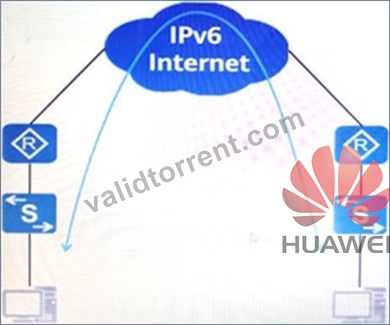
- A. 2001:FDC:1/64 2001:FDC::2/64
- B. 2001:FDC::1/64 2001:FDC1::2/64
- C. FD00:1AC0:872E::1/64 FDO0:2BE1:2320::1/64
- D. FE80::1/64 FE80::2/64
Answer: B
NEW QUESTION # 101
Which of the following descriptions about IGMP Proxy are correct? (Multiple choice)
- A. The IGMP Proxy function can reduce the number of IGMP membership reports received by the IGMP querier
- B. IGMP Proxy can be deployed on a Layer 2 device between the IGMP querier and member hosts
- C. IGMP Proxy cannot be deployed on a Layer 3 device between the IGMP querier and member hosts
- D. The IGMP Proxy function cannot reduce the number of IGMP member leave messages received by the IGMP querier
Answer: A,B
NEW QUESTION # 102
Regarding the description of Router ID in OSPF, which of the following is incorrect?
- A. If the router-id command is not manually configured and a loopback interface address is configured, select the largest loopback interface address as the Router ID.
- B. If the router-id command is not configured and the Loopback interface address is not configured, select the largest one from the IP addresses of its physical interfaces as the Router ID.
- C. If the Router ID is manually configured using the router-id command, OSPF will use this Router ID first.
- D. After the Router ID is changed, the Router ID of each protocol will change, no additional operations are required.
Answer: D
NEW QUESTION # 103
Regarding the content contained in the UPDATE message, the wrong description is:
- A. UPDATE contains the local AS number
- B. UPDATE contains reachable route prefix information
- C. UPDATE contains revoked routing prefix information
- D. UPDATE contains path attribute
Answer: A
NEW QUESTION # 104
Which of the following descriptions about configuring the set-overload command in IS-IS is correct?
- A. This command is used to enable IS-IS to automatically calculate the interface cost according to the bandwidth
- B. This command is used to set the overload flag bit of non-pseudo-node LSP
- C. This command is used to specify that the Hello message sent after the device restarts carries the SA bit
- D. This command allows the device to set the time for the system to maintain the overload flag according to the state of BGP convergence
Answer: B
NEW QUESTION # 105
Which of the following statements about multicast packet forwarding is true?
- A. IGMP snooping cannot control the scope of multicast traffic flooding on a Layer 2 network.
- B. The source address of a multicast packet is a unicast address.
- C. In multicast transmission, the destination address of a packet can be the unicast address of a host.
- D. If a multicast data packet fails the RPF check, the packet must have been received through a sub-optimal interface. However, this interface still receives and forwards the multicast traffic downstream.
Answer: D
NEW QUESTION # 106
In inter-AC roaming scenarios, an AC can function as the mobility server of multiple mobility groups, but can be added only to one mobility group.
- A. FALSE
- B. TRUE
Answer: B
Explanation:
In inter-AC roaming scenarios, an AC (Access Controller) can serve as the mobility server for multiple mobility groups, enabling it to manage roaming among multiple groups. However, an AC can only belong to one specific mobility group. This constraint ensures that mobility management remains streamlined and avoids conflicts. Huawei WLAN mobility configuration guides validate this setup .
NEW QUESTION # 107
On an OSPF network, if two routers with the same router ID run in different areas and one of the routers is an ASBR, LSA flapping occurs.
- A. FALSE
- B. TRUE
Answer: B
Explanation:
Understanding Router ID and Its Role in OSPF:
In OSPF, the Router ID uniquely identifies a router within the OSPF domain. If two routers are configured with the same Router ID, it can lead to issues such as LSA conflicts and flapping. This is because the Router ID is used as a key in OSPF operations, including LSA generation and database synchronization.
HCIP-Datacom-Core Technology Training Material (OSPF Basics - Router ID and LSA Handling).
Scenario Details:
Different Areas: Even if the two routers belong to different areas, the Router ID remains globally significant in the OSPF domain. This means that any duplication of Router IDs will confuse OSPF mechanisms.
ASBR (Autonomous System Boundary Router): When one of the routers is an ASBR, it generates Type 4 and Type 5 LSAs to describe external routes. These LSAs use the Router ID asan identifier. If another router in the network has the same Router ID, conflicts occur during LSDB synchronization.
Reference:HCIP-Datacom Advanced Routing & Switching Technology (LSA Types and ASBR Operations).
Impact of Router ID Duplication:
LSA Flapping: The OSPF process receives conflicting LSAs from routers with the same Router ID. This results in continuous updates and withdrawals of these LSAs, causing flapping.
Routing Instability: LSA flapping leads to frequent recalculations of the OSPF shortest path tree (SPT), affecting overall network stability.
Reference:HCIE-Datacom V1.0 Training Material (OSPF Troubleshooting and Best Practices).
Conclusion:
The statement isTRUE. LSA flapping occurs when two routers in an OSPF network have the same Router ID, even if they are in different areas and one is an ASBR. This is due to the global significance of Router IDs in OSPF and the role they play in LSA generation and propagation.
NEW QUESTION # 108
Drag and Drop Question
OSPF networks are classified into four types of networks by link layer protocol. Drag the following link layer protocols to the corresponding network types. (Token is reusable)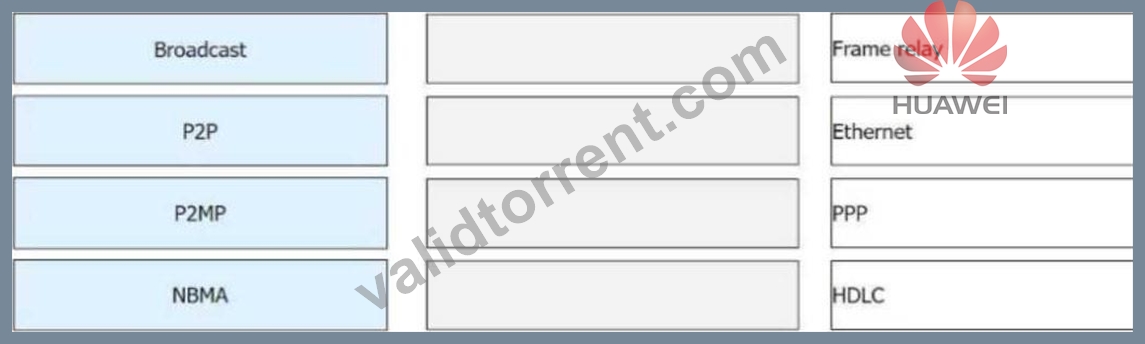
Answer:
Explanation: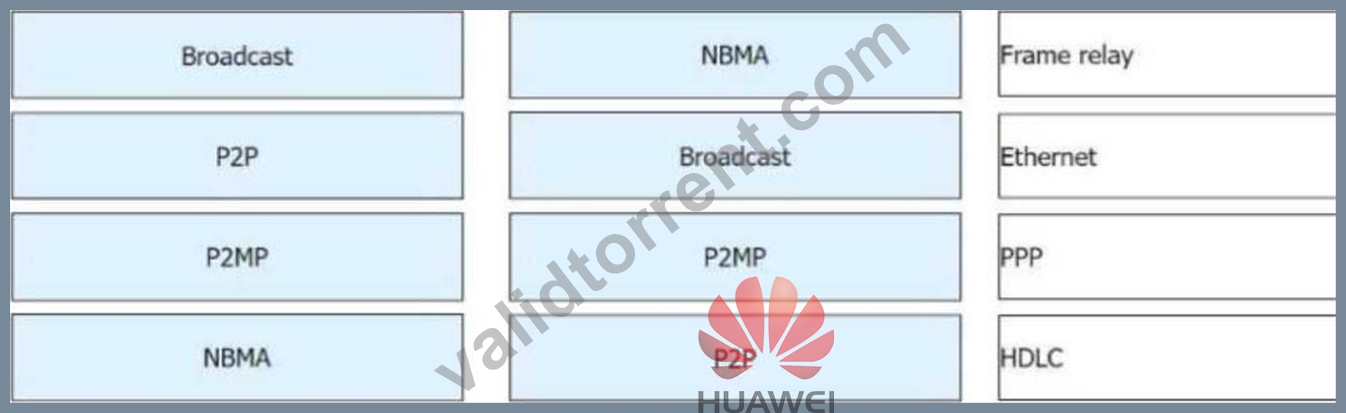
NEW QUESTION # 109
......
The Ultimate Huawei H12-821_V1.0 Dumps PDF Review: https://www.validtorrent.com/H12-821_V1.0-valid-exam-torrent.html
Achieve The Utmost Performance In H12-821_V1.0 Exam Pass Guaranteed: https://drive.google.com/open?id=1SzARXa4sURnHivS0xxPlE7-B1Hbr8TH6